What Is an Automated Agency and When It Makes Sense

If you run a local business, you probably feel the tension between “we need more leads” and “we don’t have time for more admin.” That tension is exactly why the idea of an automated agency has become popular. But the term is used loosely, and not every “automated” offer is actually a good fit for your business.
This guide breaks down what an automated agency is, what it is not, and the situations where it tends to deliver the best results for local businesses in Norway and the US.
What is an automated agency?
An automated agency is a service provider that delivers a repeatable outcome (usually marketing growth, lead flow, or operational efficiency) using standardized systems and automation tools, with humans handling the parts that truly require judgment.
In practice, “automated” rarely means “no people.” It usually means:
- The agency productizes common work (for example, local SEO foundations, landing pages, reporting).
- Intake, setup, follow-up, and measurement are system-driven.
- Manual work is reserved for strategy, quality control, and exceptions.
A useful way to think about it is: a traditional agency often sells time (hours, retainers built around labor). An automated agency sells a process that’s designed to produce a predictable result.
What an automated agency is not
A lot of disappointment comes from mismatched expectations. An automated agency is not:
- A “set and forget” black box. If no one can explain what’s being done and why, that is not automation, it’s opacity.
- A single tool with a subscription. Tools can be part of it, but an agency should include implementation and accountability.
- A guarantee of results regardless of market realities. Automation can increase speed and consistency, but it can’t fix weak positioning, poor reviews, or a market with low demand.
The building blocks of an automated agency (what actually gets automated)
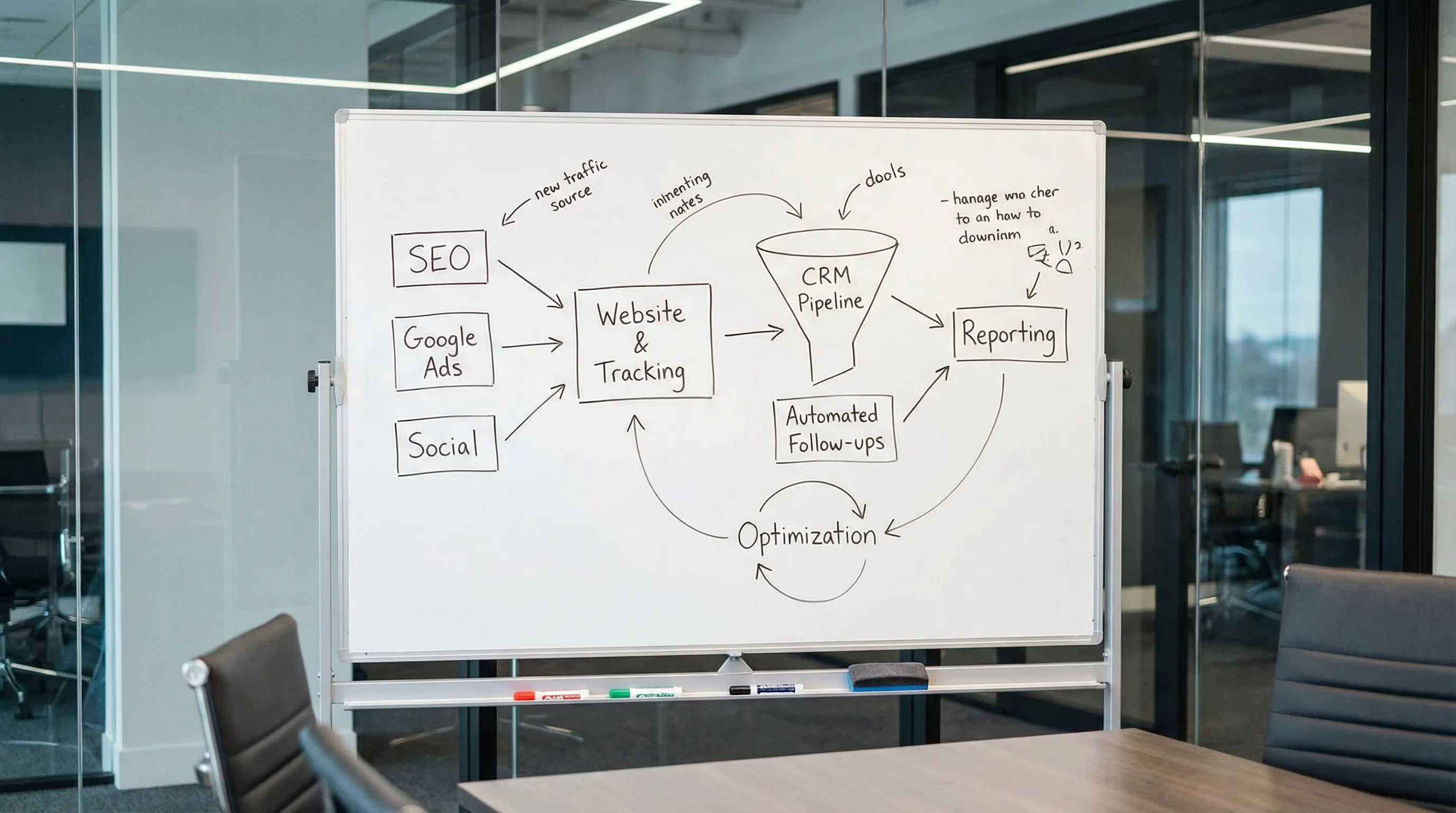
Most automated agencies standardize and automate the same four layers.
1) Lead capture and follow-up
This is the “speed to lead” layer, where automation often creates immediate gains.
Examples:
- Website forms that route inquiries to the right pipeline
- SMS or email follow-ups that confirm the request and set expectations
- Automated booking links and reminders
- Call tracking and attribution setup so you can tell what’s working
2) Fulfillment workflows
This is how deliverables are produced consistently.
For local marketing, fulfillment automation might include:
- Templated landing pages and service pages (with local customization)
- Checklists for on-page SEO, technical SEO basics, and tracking
- Standard operating procedures (SOPs) for launching and monitoring Google Ads
- Automated QA steps (broken links, indexing checks, speed checks)
3) Reporting and decision support
Automated agencies tend to “instrument” performance early so decisions are faster.
Common elements:
- Automated reporting dashboards or scheduled summaries
- Alerts when lead volume drops, spend spikes, or conversions stop tracking
- Weekly or monthly review loops, where humans interpret the data and adjust strategy
4) Client communication and account operations
This is the part that quietly saves time for both sides.
- Automated onboarding (access requests, intake forms, asset collection)
- Centralized documentation (logins, brand assets, campaign notes)
- Billing, renewal, and scope control systems
Why automated agencies are growing now
Two forces are pushing this model forward:
- Local competition is increasing. Many service categories are crowded, and speed plus consistency matters.
- Marketing execution has become more technical. Tracking, consent, conversion APIs, and measurement require discipline. Systems reduce mistakes.
For local businesses, the upside is that you can get a “professional-grade” baseline faster, without paying for weeks of manual setup.
Automated agency vs traditional agency: what’s the real difference?
Here’s a practical comparison that helps set expectations.
| Dimension | Automated agency (system-led) | Traditional agency (people-led) |
|---|---|---|
| Delivery | Standardized, repeatable workflows | Custom workflows, varies by team |
| Speed | Faster setup in common use cases | Often slower due to bespoke work |
| Consistency | High (checklists and templates) | Depends on account team quality |
| Custom strategy | Usually limited to defined options | Often broader, more open-ended |
| Best for | Local services, multi-location, clear offers | Complex brands, heavy creative, unique funnels |
| Risk | “Cookie-cutter” if poorly implemented | Inconsistency, higher cost, slower execution |
Neither model is “better” universally. The fit depends on your goals, your market, and how standard your needs are.
When it makes sense to hire an automated agency
An automated agency tends to work best when you want a clear, measurable outcome and your situation matches a repeatable playbook.
You have a straightforward offer that people already search for
Think: dentist, physiotherapist, roofer, plumber, electrician, immigration attorney, med spa, home cleaning.
If customers already search for what you sell, automation helps you capture demand efficiently through:
- SEO foundations + local service pages
- Google Search Ads built around high-intent queries
- Tracking + follow-up that turns inquiries into booked jobs
You care more about predictable lead flow than “big brand” creative
If your main objective is calls, bookings, quote requests, or store visits, automation is often a strong fit.
You can still have good design and messaging, but the priority becomes:
- conversion rate
- cost per lead
- lead quality
- booked job rate
You want speed and lower risk in the early stage
If you are launching a new location, changing service focus, or just want to stop procrastinating on your website, the “system” approach can reduce friction.
For example, Kvitberg Marketing’s offer of free, pre-built, SEO-optimized websites (with no upfront commitment and a walkthrough before you decide) aligns with this logic: you can evaluate the finished product before spending money, which reduces risk for local owners who have been burned by vague website promises.
You have enough lead volume (or budget) for learning cycles
Automation improves efficiency, but marketing still needs data.
As a rule of thumb:
- If you can generate a steady stream of clicks, calls, or form fills, optimization becomes meaningful.
- If your budget is too small to produce consistent conversion data, even the best system will struggle to “learn” what works.
You are willing to adopt a simple operating rhythm
Automated agencies deliver best results when you can commit to light structure, such as:
- responding to leads quickly
- tagging lead quality (good fit vs poor fit)
- showing up to a short monthly review
If you want results but refuse any process change, the “automation” won’t have anything to connect to.
When an automated agency is a bad fit
It’s also important to call out when you should not choose this model.
You need heavy differentiation, storytelling, or creative iteration
If your success depends on brand campaigns, unique creative concepts, or high-touch content production, a productized system may feel limiting.
Your business model is complex or the sales process is long
If you sell enterprise services, highly regulated offers, or custom projects with multi-stakeholder approvals, you may need a more bespoke agency approach.
You don’t control the basics (tracking, access, ownership)
Automation depends on clean inputs.
If you cannot get:
- access to Google Business Profile, Google Ads, Analytics, Search Console
- reliable conversion tracking (calls, forms, bookings)
- clear ownership of domains and accounts
Then an automated agency either slows down or starts making decisions in the dark.
You expect automation to replace your customer experience
No automation fixes:
- slow responses to inquiries
- missed calls
- weak sales scripts
- poor fulfillment that creates bad reviews
Automation can multiply what’s already there, including problems.
A practical checklist: should you choose an automated agency?
If you can answer “yes” to most of the following, you are likely in a good fit zone:
- You sell a service with clear, search-driven intent (people actively look for it).
- You can handle more leads operationally (or you can hire to fulfill demand).
- You can respond to leads fast (same day at minimum).
- You are comfortable with standardized deliverables (templates, frameworks).
- You want measurable outcomes (calls, forms, bookings), not vague “brand awareness.”
- You can commit to basic tracking and a simple review cadence.
If you answer “no” to several, you may need to fix internal operations first, or choose a more bespoke partner.
What to ask before hiring an automated agency (to avoid disappointment)
Because “automation” is a broad label, you should qualify the agency like you would any other serious vendor.
Ask to see the system, not just the results
Good questions include:
- How do you onboard, what do you need from me, and how long does it take?
- What is standardized vs customized?
- How do you track conversions, and what happens if tracking breaks?
- What does the monthly optimization process look like?
A credible provider can walk you through their process clearly.
Confirm ownership and portability
You should know, in plain language:
- Who owns the ad accounts, domains, and creative assets?
- Can you leave without losing everything?
- What happens to logins and tracking if you end the relationship?
Ask how humans stay involved
Automation should free up expert attention, not eliminate it.
Look for clarity on:
- who monitors performance
- who handles exceptions and edge cases
- how strategy decisions get made
A note on social distribution automation (and going local in new markets)
Some automated agencies expand beyond search and websites into social distribution, especially for businesses that want reach in specific geographies.
If your challenge is posting content that actually reaches people in the country you are targeting, tools like TokPortal for posting TikToks to real local audiences highlight a different kind of automation: removing geographic barriers so organic content is published through locally warmed accounts. That can be relevant for multi-location brands, tourism operators, or businesses expanding from Norway into US cities (and vice versa).
The takeaway is not “everyone needs TikTok automation.” It’s that the best automation is targeted at the exact bottleneck that is holding growth back.
How to start with an automated agency (without overcommitting)
The smartest way to adopt this model is to begin with a bounded pilot.
A typical low-risk path looks like this:
- Start with one core asset (a conversion-focused website or landing page) and ensure tracking works.
- Add one acquisition channel (often Google Search Ads for high-intent local demand, or an SEO foundation if you are investing long-term).
- Run for long enough to get signal (often 30 to 90 days, depending on traffic and budget).
- Make decisions based on business outcomes, not vanity metrics.
If the process is solid, you will feel it quickly: fewer dropped leads, clearer reporting, faster iterations, and more predictable lead flow.
The bottom line
An automated agency makes sense when you want speed, consistency, and measurable outcomes from a repeatable marketing playbook, and you are willing to support it with basic operational discipline (fast response times, proper tracking, and a simple review cadence).
It’s a poor fit when you need heavy bespoke creative, have a complex sales process, or expect automation to compensate for a broken customer experience.
If you evaluate the model based on systems and fit, not buzzwords, an automated agency can be one of the most efficient ways for a local business to grow in 2026.