Scale Marketing Without Breaking Your Funnel

Most businesses don’t fail at scaling because they “ran out of budget.” They fail because they scaled one part of the machine (ads, content, outreach) faster than the rest of the funnel could handle.
That’s what “breaking your funnel” looks like in real life:
- Lead volume goes up, but close rate drops.
- Website sessions climb, but conversions stay flat.
- Sales gets overwhelmed, so speed-to-lead gets worse.
- Reporting becomes noisy, so decisions get reactive.
Scaling should feel boring. Predictable. Like adding capacity to a system that is already stable.
Below is a practical framework to scale marketing without breaking your funnel, whether you’re a local business in Norway, a service company in the US, or a niche B2B team.
What “breaking the funnel” actually means
A funnel breaks when one stage increases demand faster than the next stage can convert it.
If you double traffic without strengthening your offer, your landing pages, and your follow-up, you do not get 2x revenue. You get:
- Higher acquisition costs (platforms optimize toward what you feed them)
- Lower lead quality (broader targeting and weaker intent)
- Lower conversion rate (message mismatch, slower pages, confusion)
- Sales bottlenecks (unanswered calls, delayed quotes, missed meetings)
Scaling responsibly means building guardrails so every growth step is validated end-to-end.
Start with the only scaling question that matters
Before adding new channels or increasing spend, answer this:
Where does your funnel currently lose “good-fit” buyers, and why?
Not “Where is volume low?” Low volume is often a symptom. The root cause is usually one of these:
- The offer is unclear, generic, or hard to trust
- The traffic source is misaligned with intent
- The landing page does not match the ad or query
- Conversion friction is high (slow pages, too many steps, weak CTA)
- Lead handling is inconsistent (no speed-to-lead, no qualification, no nurturing)
If you fix the biggest leak first, scaling is safer because you are expanding a stronger system.
Funnel guardrails: the metrics that keep growth sane
When you scale marketing, you need a small set of metrics that act like circuit breakers. If they drift, you pause expansion and fix the constraint.
Here’s a simple set that works for most local services and B2B teams.
| Funnel stage | Guardrail metric | What it protects | Common “break” signal |
|---|---|---|---|
| Acquisition | Cost per qualified visit or click | Budget efficiency and targeting | Spend rises but engagement drops |
| Landing page | Conversion rate (visit to lead) | Message match and clarity | More traffic, same or fewer leads |
| Lead quality | % qualified leads | Sales efficiency | More leads, fewer good fits |
| Sales speed | Speed-to-lead | Close rate | Follow-up slows as volume rises |
| Revenue | CAC vs gross margin | Profitability | Growth that looks good but loses money |
Two notes:
- “Qualified” must be defined. If you cannot define it, you cannot scale it.
- Track trends, not perfection. Your goal is stability, not vanity.
The Scale Stack: four layers you must strengthen (in order)
Think of scaling like stacking blocks. If the lower blocks are weak, the higher blocks collapse.
1) Offer and positioning (the conversion multiplier)
If your offer is “We do X,” you will always pay more to acquire customers than the competitor who says, “We do X for Y, with Z outcome, in N days.”
For local businesses, strong offers are usually built from:
- A specific promise (what problem you solve)
- A specific audience (who it is for)
- Proof (reviews, cases, before/after, certifications)
- A low-friction next step (quote, inspection, call, booking)
If you scale ads or SEO before tightening the offer, your growth will be expensive.
2) Website and landing experience (the trust engine)
When buyers click, they are asking: “Is this real, relevant, and safe to choose?”
Your site should answer quickly:
- What you do
- Who it’s for (service area, niche, industry)
- Why you (proof)
- What happens next (CTA)
It also needs technical competence. Google is explicit that factors like usability and performance matter for user experience, and page experience has been a long-running focus in their documentation (see Google Search Central).
If you are not confident your site is doing this job, fixing it is often the highest ROI “marketing” move you can make.
Kvitberg Marketing’s approach is built around this reality: we create pre-built, SEO-optimized websites for local businesses for free, with no commitment upfront, then you decide after reviewing the finished site. If your funnel is fragile, upgrading the foundation before scaling traffic is usually the safest path. You can start at the Kvitberg Marketing homepage to see the model.
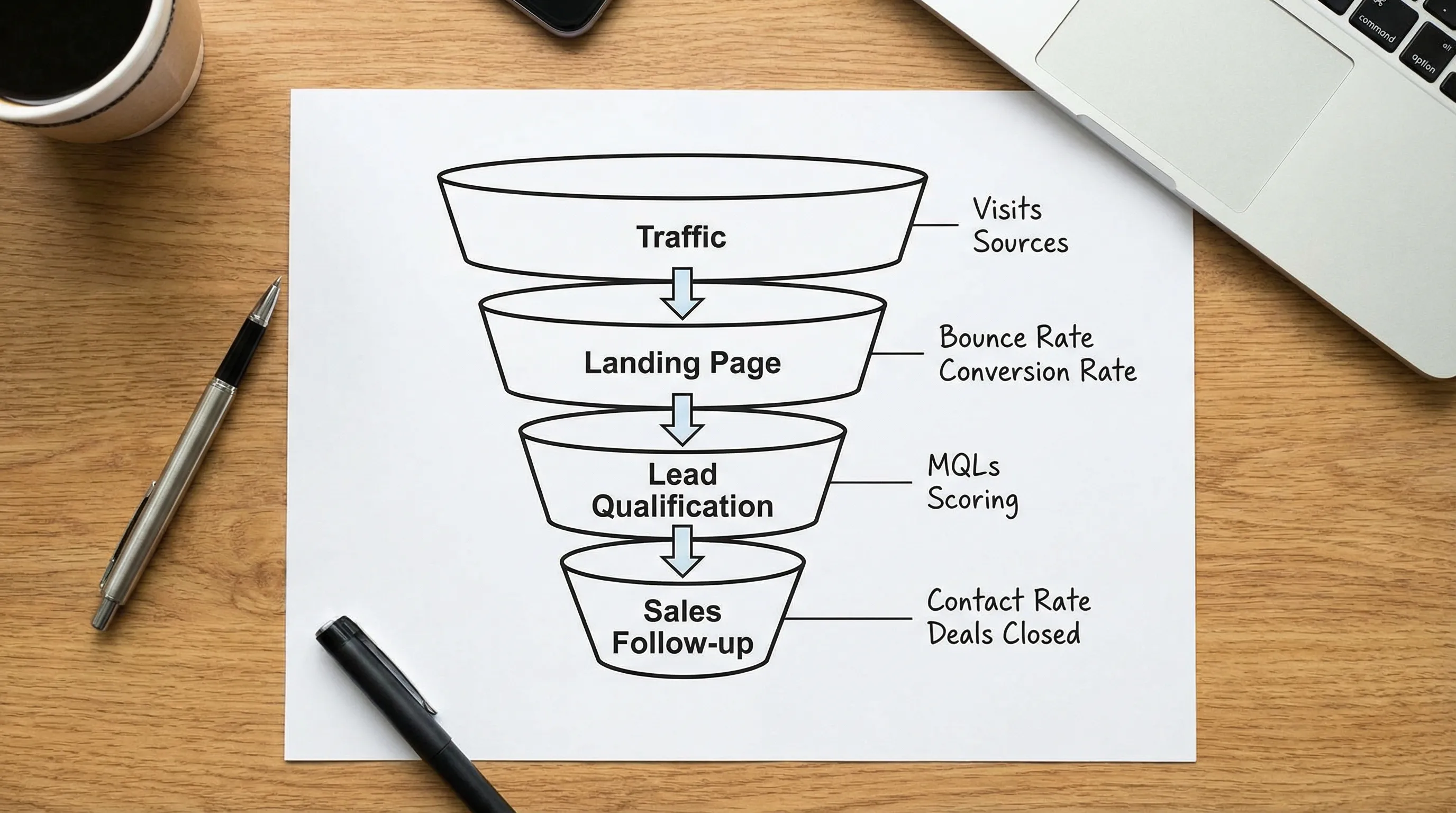
3) Lead capture and qualification (the anti-waste layer)
A common scaling trap is collecting more leads that your team cannot qualify quickly.
Instead, design lead capture so it filters naturally:
- Use forms that ask only what you will actually use (name, contact, key qualifier)
- Add one “fit” question (service area, budget range, timeline, project type)
- Offer an alternative path for low-intent visitors (download, email series, callback)
This is not about making it hard to convert. It’s about ensuring your “lead” metric means something when volume grows.
4) Follow-up system (where scaling becomes revenue)
If response times get worse when lead volume rises, scaling will reduce revenue even as spend increases.
Your minimum viable system should include:
- A clear owner for each lead source
- A response time goal your team can hit consistently
- A simple qualification script (so “qualified” is consistent)
- A defined next step (booking link, calendar slots, quote workflow)
- Lightweight nurture for “not now” leads
For many local businesses, improving follow-up consistency increases booked jobs more than any new channel.
How to scale marketing safely: a step-by-step playbook
Step 1: Pick one growth constraint to solve
Choose the stage that limits revenue today, not the stage that feels most exciting.
Examples:
- You get plenty of clicks, but few leads (landing page problem).
- You get plenty of leads, but sales hates them (qualification problem).
- You close well, but pipeline is too small (acquisition problem).
Solve one constraint, then scale.
Step 2: Increase volume in controlled increments
Scaling is an experiment. Treat it like one.
Practical rules:
- Increase budgets in steps (not huge jumps)
- Change one variable at a time when possible (audience, creative, landing page, offer)
- Hold the line on guardrails (if qualified rate drops, stop and fix)
Ad platforms learn from conversion data. If you flood the system with low-quality conversions, performance can degrade even after you “fix” it.
Step 3: Expand depth before breadth
Most funnels scale better by going deeper in what already works before adding new channels.
Depth expansions:
- Build more landing pages for top intent queries or services
- Improve creatives and messaging for winning ad sets
- Add remarketing to recapture high-intent visitors
- Improve local SEO pages and internal linking
Breadth expansions (do later):
- Adding new platforms
- Broadening geography too quickly
- Targeting new customer segments
Step 4: Add capacity where scaling creates pressure
Marketing does not exist in isolation. When demand goes up, operations must keep up.
For example, if you are a civil engineering or infrastructure firm scaling lead gen, you may also need to scale hiring to deliver projects. In that scenario, partnering with a team that understands niche talent markets can remove a real bottleneck. One example is specialist recruitment for civil engineering firms, which becomes relevant when growth requires roles that are hard to fill quickly.
The point is not “hire more” by default. It’s to identify the real constraint and increase capacity only where needed.
Common scaling moves, and what they tend to break
| Scaling move | What it helps | What it can break if unchecked | Safer alternative |
|---|---|---|---|
| Increase ad spend fast | Lead volume | Lead quality, CAC, sales response time | Stepwise budget increases with guardrails |
| Broaden targeting | Reach | Relevance, conversion rate | Add new ad groups by intent segment |
| Send all traffic to the homepage | Speed of launch | Message match, conversion rate | Dedicated service landing pages |
| Add more form fields | Lead quality | Form completion rate | One key qualifier question plus routing |
| Add more channels at once | Diversification | Attribution, focus, execution quality | Master one channel, then expand |
This table is the reality check: scaling is easy to start and hard to control.
A practical “scale-ready” checklist (for local businesses)
You are usually ready to scale marketing when:
- Your website clearly communicates service, area, proof, and next step
- You can track lead sources reliably (even if it’s simple)
- You know what a qualified lead is, and can measure it
- Your follow-up is consistent enough that more leads will not reduce close rate
- Your best channel has at least one repeatable campaign/page that performs steadily
If you are missing two or more, scale will likely create noise instead of growth.
Where Kvitberg Marketing fits if you want to scale without chaos
If scaling has felt unpredictable, it often means the foundation is not doing its job: the site does not convert, the message is unclear, or the funnel isn’t measurable.
Kvitberg Marketing helps local businesses de-risk that first step by delivering a completed, SEO-optimized website for free, then walking you through it so you can decide whether to buy after you see the result. If you want to scale further, optional growth services like SEO campaigns and Google Search Ads management can be layered on after the base is strong.
The safest version of scale marketing is not “more spend.” It’s a funnel that stays stable as volume rises.
If you build that stability first, growth becomes a math problem instead of a guessing game.