Performance Advertising: How to Scale Google and Meta Profitably

Performance advertising gets marketed like a simple lever: add budget, get more leads. In real accounts, scaling is where profitability usually breaks, costs spike, lead quality drops, attribution gets fuzzy, and teams start “optimizing” toward the wrong metric.
This guide is a practical framework for scaling Google Ads and Meta Ads profitably, built for local businesses (and the agencies and B2B teams supporting them). You will learn what to measure, what to fix before you scale, and which levers increase volume without destroying margin.
What “scaling profitably” actually means
Scaling is not just spending more. It is increasing results while keeping your economics intact.
In performance advertising, “profitably” usually means you can raise volume while maintaining one of these guardrails:
- Target cost per acquisition (CPA) for lead or sale
- Target return on ad spend (ROAS) for tracked revenue
- Target contribution margin (revenue minus COGS minus ad spend)
- Target payback period (how fast new customers repay CAC)
For local businesses, the cleanest definition is often: “Can we buy leads or booked jobs at a cost that still leaves healthy margin after labor and overhead?”
The 3 numbers you should lock before touching budget
If you cannot answer these, scaling is guesswork:
-
Gross margin per job or customer (or contribution margin if you can estimate fulfillment costs)
-
Lead-to-customer rate (what percentage of leads actually become paying customers)
-
Average revenue per customer (or lifetime value if you have repeat purchases)
With those, you can back into a rational target CPA.
The measurement stack that makes scaling possible
When campaigns start growing, measurement gaps widen. Before you scale spend, make sure the account can “see” conversions correctly.
Minimum viable tracking for Google and Meta
At a minimum:
- One primary conversion that represents success (purchase, booked call, qualified lead)
- Secondary conversions for diagnostic insight (form submit, call click, chat start)
- Clean UTMs and consistent naming so you can reconcile platform vs analytics vs CRM
- A way to capture lead quality (even a simple “qualified/unqualified” field in your CRM)
If you run lead gen, consider pushing offline conversion outcomes (qualified, booked, closed-won) back into Google and Meta. This is one of the highest-leverage moves for profitability because bidding learns on revenue or quality, not raw form fills.
If your team is building or validating conversion and CRM integrations, a local-first tool like DevTools for API testing and flow automation can help you reproduce requests, validate payloads, and run flows reliably in CI without guessing what your tracking endpoints actually receive.
Use business KPIs, not platform vanity metrics
Platform ROAS can be useful, but it is not the business. Add at least one “blended” KPI that reflects reality.
| KPI | What it tells you | Why it matters for scaling |
|---|---|---|
| CPA / CPL | Cost to acquire a lead or customer | Best for local lead gen and service businesses |
| Lead-to-customer rate | Down-funnel quality | Prevents scaling junk leads |
| CAC | True cost per new customer | Aligns marketing with sales outcomes |
| ROAS | Revenue divided by ad spend | Useful for ecommerce and high-volume tracked revenue |
| MER (Marketing Efficiency Ratio) | Total revenue divided by total marketing spend | Captures cross-channel overlap and halo effects |
| Contribution margin after ads | Profitability after fulfillment and ads | The real scaling guardrail |
The pre-scaling checklist (do this before increasing budgets)
Most “scaling problems” are actually conversion and offer problems.
1) Fix the offer and the landing experience first
Scaling amplifies whatever is already happening. If your landing page converts at 2 percent, doubling spend just buys you the same inefficiency, faster.
Common fixes that improve performance advertising results without increasing spend:
- Clarify one primary action (book, call, request quote)
- Add proof close to the CTA (reviews, case studies, before/after)
- Reduce friction (shorter form, fewer steps, faster load time)
- Match message from ad to landing page (same promise, same wording)
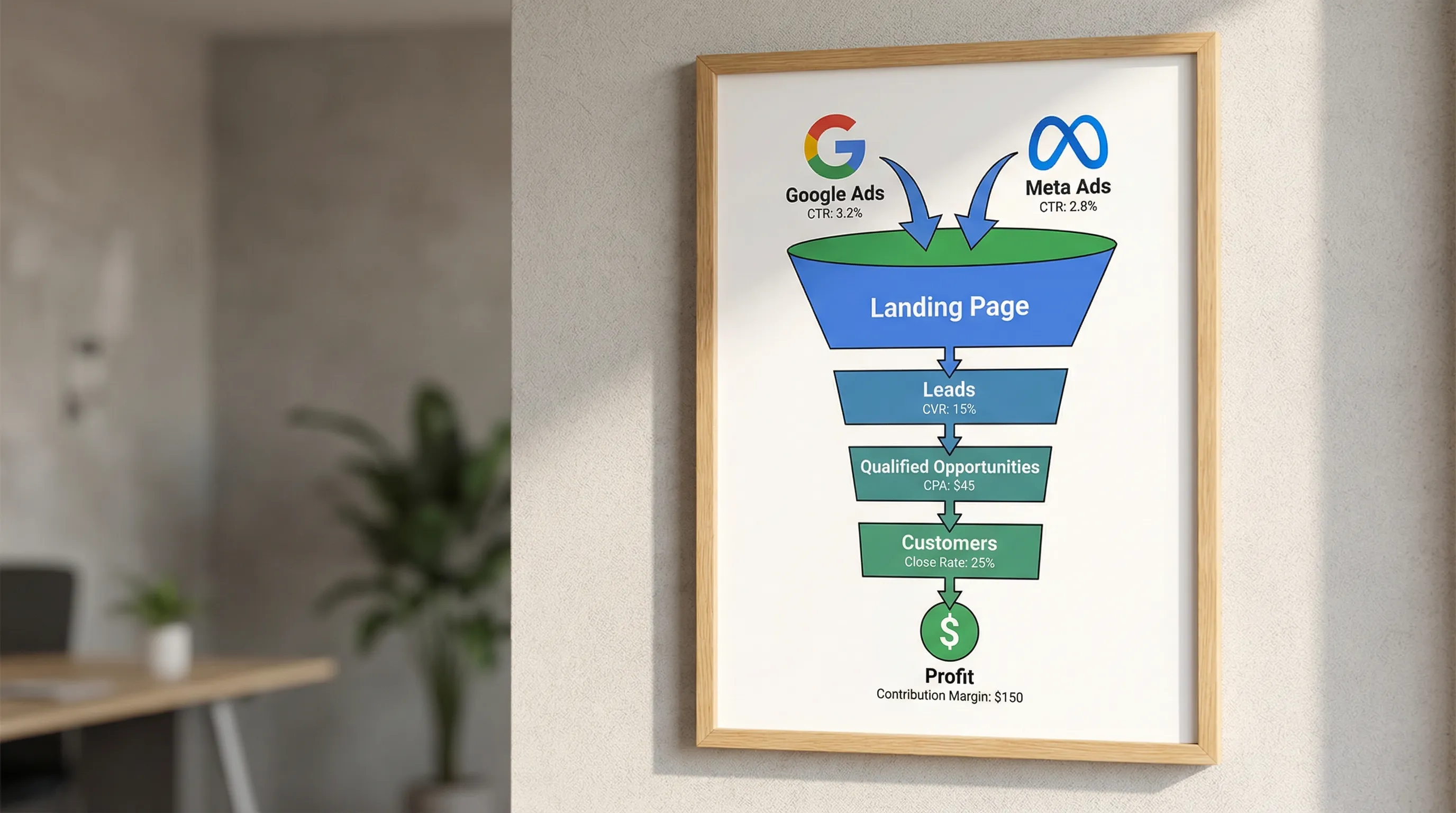
2) Ensure you have enough conversion signal
Smart bidding and algorithmic delivery need data. If you have very low volume, scaling is more about:
- Improving conversion rate
- Broadening targeting cautiously
- Consolidating campaigns and ad sets to avoid fragmenting data
As a rough rule, automated bidding systems tend to stabilize with more frequent conversion feedback. If you are generating only a few conversions per week, prioritize conversion rate and lead quality before aggressive budget growth.
3) Know what “profitable” means by geography and service line
Local businesses often have very different margins by:
- City or region
- Service category
- Customer type (residential vs commercial)
Scaling is easier when you separate what is truly profitable from what merely produces leads.
How to scale Google Ads profitably
Google is intent-driven. Scaling profitably usually means expanding reach while keeping query quality high and feeding the bidding system the right signals.
Start with the simplest scaling levers
Budget increases (done correctly)
Avoid sudden budget shocks on stable campaigns. Incremental changes help preserve learning stability.
What to watch after increases:
- Search terms quality (are you drifting into broader intent?)
- Impression share lost to budget (a sign you can scale without changing targeting)
- Conversion rate (a drop can signal you are expanding into weaker queries)
Expand coverage without exploding waste
Common expansion paths:
- Add high-intent keyword themes adjacent to your best performers
- Test broader match types with strong negatives and tight conversion definitions
- Layer in location-specific intent (city, neighborhood, “near me”) if relevant
For service businesses, query control is profitability. Scaling by “going broad” without guardrails often buys volume at the expense of lead quality.
Use the right bidding strategy for your stage
- If you have limited data, you may start with manual CPC or Maximize Clicks, then move to conversion-based bidding once tracking is stable.
- If you have consistent conversions, Target CPA is often the cleanest scaling tool for lead gen.
- If you can pass values or revenue, Target ROAS or value-based bidding can scale more efficiently.
The key is aligning the optimization event with the business outcome. If you optimize for “form submit” but sales only wants “qualified booked calls,” you are training the system to find cheap, low-intent leads.
Use experiments, not opinions
Google Ads experiments help you scale with less risk. Good experiment ideas:
- Broad match expansion vs exact/phrase only
- New landing page variant (conversion rate lift often beats bid tweaks)
- tCPA adjustments paired with improved lead qualification signals
Make Performance Max work for you (instead of against you)
Performance Max can scale volume, but it can also blur where results come from.
Profit-friendly PMax habits:
- Provide high-quality creative assets and clear business signals
- Use audience signals as a starting point, not a hard constraint
- Monitor search term insights and placement quality where available
- Keep a tight definition of primary conversions
How to scale Meta Ads profitably
Meta is demand creation and demand capture through targeting and creative. Scaling is primarily a creative and offer game.
Consolidate to let delivery learn
Accounts often fragment data across too many ad sets. Consolidation can improve stability:
- Fewer campaigns
- Fewer ad sets
- More creative variation inside those ad sets
This increases the data per decision and often improves CPA consistency.
Increase budget without resetting performance
Meta can be sensitive to big changes. Practical approaches include:
- Gradual budget increases on winners
- Duplicating a proven ad set into a new budget “track” if you need more spend without destabilizing the original
- Letting a Campaign Budget Optimization approach allocate spend across similar audiences
Scale with creative volume, not just spend
If you want to scale Meta profitably, the highest leverage input is usually more high-quality ads, not more targeting complexity.
A sustainable creative system includes:
- Multiple angles (price, speed, trust, outcome, risk reversal)
- Multiple formats (short video, testimonials, static, UGC-style)
- A testing cadence (weekly or biweekly refresh)
When CPA rises as you scale, it is often creative fatigue or weak message-market fit, not “the algorithm.”
Use the right guardrails for your objective
For lead gen:
- Optimize for the conversion that best predicts quality (not just volume)
- If possible, send back qualified outcomes (offline conversions)
For ecommerce or revenue tracking:
- Ensure pixel + Conversions API are configured correctly
- Consider value optimization if you have enough purchase volume and reliable values
A practical scaling framework: volume, efficiency, and risk
When you scale, you are trading off three things:
| Scaling lever | Usually increases | Common risk | How to manage it |
|---|---|---|---|
| Raise budgets on winners | Volume | CPA inflation from weaker inventory | Increase in steps, monitor CVR and query quality |
| Broaden targeting/keywords | Volume | Lower intent, lower lead quality | Tight conversions, strong negatives, qualification feedback |
| Add new geos/services | Volume | Unknown economics by segment | Segment reporting, start small, validate margins |
| Increase bids / loosen tCPA | Volume | Paying more per conversion | Only if margins support it, use incrementality checks |
| Add more creative variants | Efficiency and volume | Time cost, poor testing discipline | Simple test plan, consistent reporting |
| Improve landing page CVR | Efficiency | Requires web work | Prioritize speed, clarity, proof, friction reduction |
If you want “more” while keeping profitability, the safest sequence is:
- Improve conversion rate and lead quality
- Increase creative volume and messaging coverage
- Scale budgets where you are losing impression share (Google) or where delivery is stable (Meta)
- Expand into new segments once you have profitable proof
Common scaling mistakes (and how to avoid them)
Scaling spend before fixing tracking
If the pixel, tags, or conversion definitions are wrong, scaling teaches platforms the wrong lesson faster.
Optimizing for cheap leads instead of qualified outcomes
Cheap leads are not a win if your sales team cannot close them. Add qualification, route leads correctly, and feed outcomes back into the ad platforms when possible.
Changing too many variables at once
If you adjust budgets, bids, creatives, and landing pages in the same week, you cannot tell what caused the result.
Ignoring seasonality and capacity
Local businesses can scale marketing past operational capacity, which hurts reviews and long-term demand. Make sure fulfillment and response times scale with ad spend.
Where SEO and your website fit into performance advertising
Paid media scales best when the website experience is fast, clear, and built to convert. Even small improvements can reduce CPA and increase the ceiling you can profitably spend.
If your current site is outdated or slow, consider prioritizing a conversion-focused rebuild before scaling ads. At Kvitberg Marketing, we build pre-built, professional, SEO-optimized websites for local businesses for free, with no upfront commitment. You review the finished site in a short walkthrough, and only decide to buy if you like the result.
That model is particularly useful when you want to scale Google and Meta but do not want to gamble ad spend on a weak landing experience.
Frequently Asked Questions
What is performance advertising? Performance advertising is paid marketing optimized around measurable outcomes, like leads, purchases, or booked calls, rather than awareness metrics alone.
How do I know if I am ready to scale Google Ads or Meta Ads? You are ready when tracking is reliable, you have consistent conversions, you know your target CPA or ROAS from real margins, and your landing page converts consistently.
Why does CPA increase when I increase budget? As you scale, platforms often reach less efficient inventory or broader intent. You can reduce CPA inflation by improving conversion rate, expanding carefully, and increasing creative quality and volume.
Should I scale on Google or Meta first? If you have high-intent demand (people searching for your service), Google often scales more predictably. Meta can scale faster with strong creative and offers, especially if demand is seasonal or you need to create it.
What is the fastest way to improve profitability without reducing spend? Improve landing page conversion rate, fix lead quality feedback loops (qualified vs unqualified), and align optimization events with real business outcomes.
Get a website that is ready to scale ads
If you want to scale performance advertising profitably, start by making sure your website can convert the traffic you are about to buy.
Kvitberg Marketing builds free, SEO-optimized websites for local businesses with no upfront commitment. Submit an inquiry, get a finished site, then decide if you want to move forward after a walkthrough. If you want growth support after that, we also offer optional SEO campaigns and Google Search Ads management.
Learn more at Kvitberg Marketing.