Marketing for IT Services: Get More Qualified Leads in 2026

In 2026, buyers of IT services behave like buyers of any other high-stakes B2B solution: they do research quietly, compare providers fast, and only reach out when they believe you are credible, specific, and safe to bet on. If your marketing is broad (“IT support for everyone”), you will get tire-kickers, price shoppers, and leads that never turn into projects.
This guide focuses on marketing for IT services that produces qualified leads, meaning prospects who match your ideal customer profile (ICP), have a real problem, and are ready to evaluate providers.
Start with positioning that filters out bad leads
Most IT service companies try to fix lead quality later with qualification calls. The faster path is to shape demand up front.
Define your ICP in operational terms. Not “SMBs,” but:
- Industry (health clinics, logistics, accounting firms, manufacturing)
- Employee count (for example 10 to 100)
- Tech environment (Microsoft 365, Google Workspace, hybrid, regulated)
- Compliance and risk profile (HIPAA-adjacent workflows in the US, GDPR-heavy operations in the EU/EEA)
- Buying trigger (recent breach, new office, new compliance requirement, failed MSP relationship)
Pick a clear primary offer. IT services pages often list 12 services and no decision. In 2026, clarity wins.
Examples of “primary offers” that tend to convert well:
- Managed IT for 10 to 50 employee companies
- Microsoft 365 hardening and security baselines
- Cybersecurity assessment with remediation roadmap
- Network refresh and office move support
Once you pick a primary offer, your website, SEO content, and ads can reinforce the same promise.
Your website is the lead quality engine (not just a brochure)
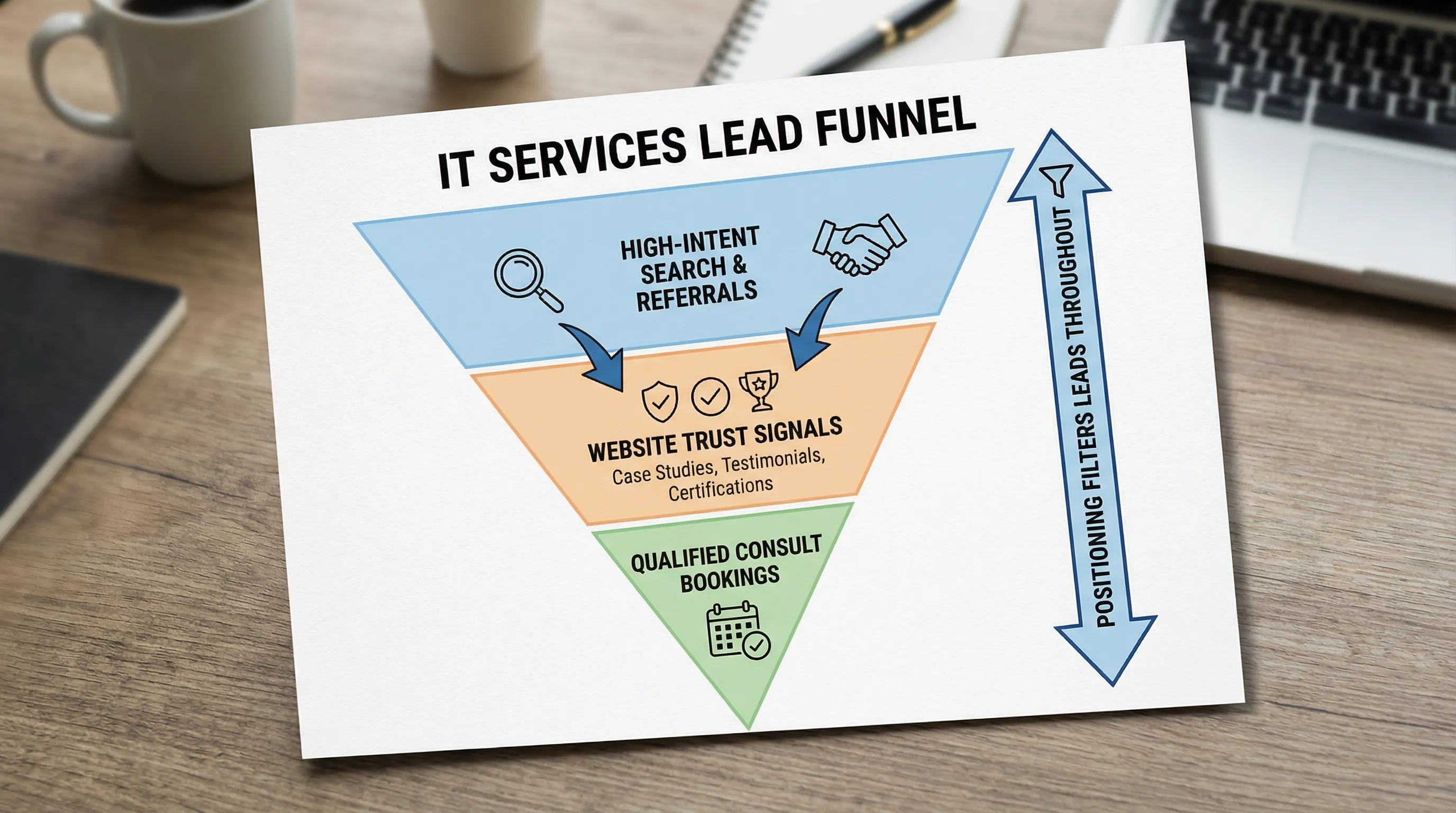
If you want better leads, your website must do three jobs simultaneously: build trust, communicate fit, and make the next step easy.
What high-converting IT services sites include in 2026
Trust signals that reduce perceived risk:
- Real case studies with context (industry, constraints, measurable outcome)
- Clear service boundaries (what you do and do not do)
- Security and privacy fundamentals (data handling, tools you use, access controls in plain language)
- Team credibility (certifications, vendor partnerships, years in business, but tied to outcomes)
Conversion fundamentals:
- A primary CTA that matches buyer intent (book an assessment, request a quote, schedule a consult)
- Short forms with a qualification question or two (company size, environment, urgency)
- Dedicated landing pages for core services (not one page for everything)
Proof over promises: replace “best IT support” with specific language like “support for 15 to 75 seat Microsoft 365 environments” or “24-hour response SLA for managed clients.”
Google also emphasizes trust and first-hand experience in its guidance on creating helpful, people-first content, which is especially relevant for “your money or your life” adjacent topics like security and risk management. See Google Search Central’s documentation on creating helpful content.
SEO for IT services in 2026: build authority around problems, not keywords
SEO still produces some of the best leads for IT services because it captures demand when a buyer is actively searching for help. The difference in 2026 is that:
- Buyers expect deep, practical answers (not thin “what is cybersecurity” pages).
- Search engines reward credible, experience-based content.
- You must cover both service intent (hire someone) and problem intent (diagnose an issue).
The page types that consistently drive qualified leads
A strong IT services SEO strategy usually combines the page types below.
| Page type | Example | Primary goal | Best for |
|---|---|---|---|
| Service page | “Managed IT Services for Accounting Firms” | Convert | Bottom-of-funnel leads |
| Problem page | “How to respond to a ransomware incident (first 24 hours)” | Build trust, capture early intent | Mid-funnel leads |
| Comparison page | “In-house IT vs MSP: cost, risk, and coverage” | Help evaluation | High-quality evaluators |
| Case study | “How we reduced phishing incidents after M365 hardening” | Proof | Decision-stage |
| Local page (when relevant) | “IT Support in [City]” | Local intent | Smaller markets, local buyers |
Content that earns trust in IT services
When your services touch security, uptime, and compliance, content should read like it was written by practitioners. That means:
- Include assumptions and constraints (environment, user count, tooling)
- Explain trade-offs (speed vs certainty in incident response)
- Provide checklists that reflect real execution (without giving away sensitive playbooks)
- Add “who this is for” and “when to bring in an expert” sections
This approach improves conversion quality because it signals competence to serious buyers and discourages the “just curious” crowd.
Local SEO: still valuable, but only if you commit
For local IT companies, a well-managed Google Business Profile can drive calls and direction requests. Follow Google’s official guidance for Google Business Profile and keep your info consistent across key directories.
Local SEO tends to work best when you:
- Have a physical service area buyers recognize
- Get steady reviews from real clients
- Publish locally relevant proof (local case studies, local industries)
If you serve nationally or globally, focus more on niche authority pages and less on generic “IT support near me” content.
Google Search Ads: capture high-intent demand without paying for junk clicks
For many IT providers, Google Search Ads remain the fastest way to generate “ready-to-talk” leads. The catch is that broad targeting burns budget quickly.
What to do differently in 2026
Match ad groups to real services and real intent. Separate campaigns for:
- Managed IT / MSP
- Cybersecurity services (assessments, hardening, monitoring)
- Microsoft 365 support or migrations
- Emergency support (only if you can handle it operationally)
Use strong negative keywords early. Many low-quality clicks come from people seeking:
- Jobs (“IT support job”)
- Tutorials (“how to fix”)
- Consumer tech repair (phone, laptop repair)
- Free help (“cheap,” “free,” “DIY”)
Send ads to dedicated landing pages, not your homepage. Landing pages should mirror the query and include:
- The exact service and ideal customer (who it is for)
- A short “how we work” section
- Proof (case study snippet, testimonials, relevant experience)
- One primary CTA
Track calls and forms properly. If you do not know which campaigns produce qualified leads, you will optimize for volume, not revenue.
LinkedIn and niche channels: create demand where decision-makers pay attention
Many IT services buyers are not searching today, but they will in the next 3 to 9 months. LinkedIn, partner ecosystems, and industry communities are where you can build familiarity before a trigger event.
A practical 2026 approach:
- Publish one strong point of view per week (risk, uptime, governance, productivity)
- Turn one client story per month into a short post and a longer case study
- Use light retargeting to stay visible to people who visited your service pages
Keep the message operational, not inspirational. IT decision-makers respond to clarity like “Here’s what breaks during M365 tenant-to-tenant migrations” more than generic “digital transformation” content.
Lead qualification that increases close rates (and saves your team time)
If your sales process starts with “Tell us what you need,” you will spend hours on unqualified discovery. Instead, qualify politely and early.
Add simple qualification to every inbound path
You can qualify without being aggressive. Ask for:
- Company name and website
- Number of users or devices
- Current environment (Microsoft 365, Google Workspace, on-prem)
- What changed (trigger event)
- Timeline (this week, this month, this quarter)
Then route leads into:
- “Book a consult” for high-fit, high-urgency
- “Request assessment” for high-fit, lower urgency
- “Not a fit” response for low-fit (with a helpful resource link)
This one change typically improves lead quality more than adding new channels.
Offers that convert for IT services (without racing to the bottom)
Discounting is rarely the best lever in IT services. Risk reduction is.
Consider productized entry offers that naturally lead into ongoing work:
- Security baseline audit with prioritized remediation plan
- Microsoft 365 security configuration review
- Network and endpoint inventory with lifecycle plan
- Incident readiness review (tabletop exercise)
The goal is not to “do a cheap project.” The goal is to create a paid diagnostic that proves competence and surfaces the real scope.
Measurement: optimize for qualified leads, not form fills
In performance marketing, the easiest metric to inflate is conversions. The metric that matters is “qualified leads that become pipeline.”
A clean measurement setup includes:
- Conversion tracking for form submissions and phone calls
- A definition of “qualified” inside your CRM (industry, size, need, budget, timeline)
- Monthly review that connects channels to pipeline, not just leads
Also keep privacy compliance in mind, especially if you market in both Norway and the US. Cookie consent and tracking requirements differ, and GDPR considerations often apply when processing EU/EEA personal data.
A practical 90-day plan to get more qualified leads
If you want traction fast, focus on a small set of moves that compound.
| Timeframe | Focus | What you should ship |
|---|---|---|
| Days 1 to 15 | Positioning + website foundations | ICP definition, primary offer, dedicated service landing page, improved contact and qualification flow |
| Days 16 to 45 | Search capture | Google Search Ads to one service, negatives, call tracking, landing page iteration based on queries |
| Days 46 to 90 | Authority building | 4 to 6 high-quality problem pages, 1 case study, internal linking to service pages, basic local SEO hygiene if relevant |
This plan works because it balances short-term demand capture (ads) with long-term demand creation (SEO and proof).
If your website is the bottleneck, fix that first
Many IT service firms try to scale ads and content on top of a site that does not convert, does not communicate who it is for, or does not establish enough trust. In practice, that creates expensive lead gen.
If you want to upgrade your foundation quickly, Kvitberg Marketing builds SEO-optimized websites for local businesses for free, with no commitment upfront. You review the finished site in a short walkthrough meeting, and you only pay if you like the result. If you want help growing beyond the website, Kvitberg also offers optional add-ons like SEO campaigns and Google Search Ads management.
Learn more at Kvitberg Marketing.