Marketing for Home Services: Get More Calls Without Wasting Spend

Most home service businesses do not have a “marketing” problem, they have a wasted-spend problem. Money leaks out through broad targeting, weak tracking, slow lead response, and websites that do not turn visitors into callers.
If your goal is simple (more calls that turn into booked jobs), the best approach is a system that connects:
- Visibility (local SEO + the right ads)
- Conversion (a site and pages built to generate calls)
- Measurement (knowing which keywords, areas, and campaigns actually produce revenue)
This guide breaks down practical, proven marketing for home services, with a focus on getting more calls without throwing budget at tactics that look busy but do not pay back.
Define what “more calls” actually means (so you stop optimizing the wrong thing)
Home services marketing becomes expensive when you optimize for the wrong metric.
A high click-through rate does not matter if callers ask for services you do not offer, are outside your service area, or never book.
Use these as your core “reality” metrics:
- Cost per qualified call (a call from your service area, for a service you offer)
- Cost per booked job (the most important day-to-day metric)
- Booked job value by service (so you can bid more for profitable work)
If you do not track booked jobs yet, start with qualified calls, then add booking and revenue tracking as you tighten operations.
Build the foundation: positioning and service area clarity
Before ads or SEO, you need clarity on two things:
Your “best jobs”
Most home service companies make more profit by getting better jobs, not just more jobs.
Examples:
- HVAC: maintenance plans, installs, high-margin repairs
- Plumbing: water heaters, repipes, drain solutions
- Electrical: panel upgrades, EV chargers, rewires
- Roofing: replacements, insurance-related inspections
Write down your top 3 to 5 priority services, and build your marketing around them.
Your real service area (and what you will not do)
Overly broad service areas are a common cause of wasted spend.
If you can only serve a certain radius or a set of towns, be strict. You can always expand later once you have predictable cost per booked job.
Your website is your call-conversion engine (not a brochure)
In home services, a “good” website is one that produces calls fast and builds trust in under 10 seconds.
What a high-converting home services website needs
At minimum:
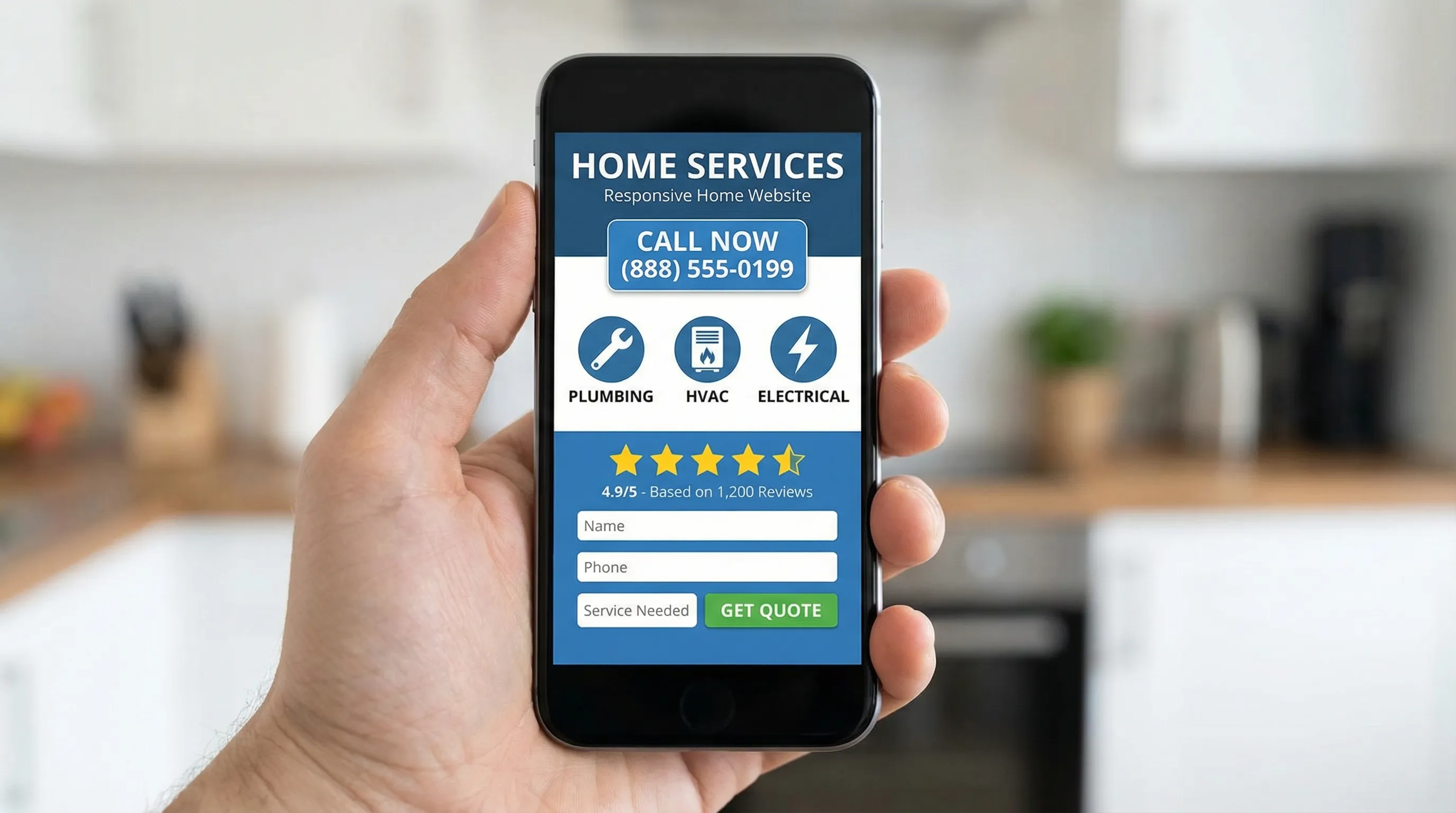
- A click-to-call button that is visible on mobile, across the site
- Service pages for each core service (not one generic “Services” page)
- Location targeting (service area pages or location sections, done carefully and honestly)
- Trust proof: reviews, licenses where relevant, insurance, guarantees, before/after photos
- Fast load speed (slow sites quietly destroy conversion rates)
- Simple contact options: call, short form, and optionally “request a quote”
If you rely on SEO or Google Ads, the page visitors land on matters as much as the campaign.
The most common website mistake that wastes ad budget
Sending paid traffic to a homepage that forces users to hunt.
For ads, use dedicated landing pages matched to intent, for example:
- “Emergency plumber” page for emergency searches
- “Water heater installation” page for high-intent install searches
- “EV charger installation” page for that specific keyword set
Each page should answer quickly:
- Are you local?
- Do you do this exact job?
- Can I trust you?
- How do I book fast?
Local SEO that generates calls (not just rankings)
Local SEO is often the highest ROI channel for home services, but only when done in a way that supports phone calls and bookings.
Google Business Profile: your most important local asset
For many home services queries, prospects never reach your website. They call directly from Google Business Profile.
Key actions:
- Choose the right primary category and supporting categories
- Fill in services (where available) and business description clearly
- Add real photos regularly (team, trucks, jobs, office if relevant)
- Post updates occasionally (offers, seasonal services)
- Make sure hours, service area, and contact details are accurate
Google’s own guidance on optimizing and managing your profile is here: Google Business Profile Help.
Reviews are not “nice to have”, they are a ranking and conversion lever
Review volume, freshness, and quality influence both click and call behavior.
Operationalize review requests:
- Ask right after successful completion
- Send a direct link via SMS
- Respond to reviews consistently (especially negative ones)
Service pages + local relevance (without spam)
For SEO, build a clean structure:
- One strong page per priority service
- Clear service area language (the places you actually serve)
- Project photos and short case examples (when you can)
Avoid thin “doorway” pages that exist only to rank in many towns. Focus on quality pages that match real demand.
Local links and citations
For home services, you can often earn strong local authority through:
- Local supplier or partner links
- Chamber of commerce and reputable directories
- Sponsorships of local events or teams
Do not chase hundreds of low-quality directory listings. A smaller set of accurate, reputable citations is safer and more effective.
Paid search that drives profitable calls (Google Ads)
Google Search Ads is usually the fastest channel to turn on call volume for home services, but it is also where wasted spend happens fastest.
Google’s official overview of Search Ads is here: About Google Search Ads.
Start with tight intent: structure by service, not by “everything you do”
A common mistake is one campaign with dozens of loosely related keywords.
Instead:
- Separate campaigns (or ad groups) by priority service
- Write ad copy that matches the exact service
- Send clicks to a matching landing page
This improves quality, lowers wasted clicks, and makes optimization clear.
Use location targeting like a scalpel
For home services, location settings matter.
- Target only the areas you serve
- Watch the “presence or interest” settings and exclude irrelevant regions when needed
- Consider bid adjustments by area if some locations convert better
Negative keywords: the fastest way to stop waste
Negative keywords prevent you from paying for the wrong intent.
Common categories to exclude (varies by trade):
- DIY and “how to” searches
- Jobs, careers, salary
- Parts-only shoppers (if you do not sell parts)
- Brand names you cannot service (if irrelevant)
Call tracking and “qualified call” definitions
In home services, not all calls are equal.
Define what counts as a conversion, for example:
- Calls longer than 45 or 60 seconds
- Calls from your service area
- Calls during business hours (plus emergency hours if applicable)
Then match your reporting to booked jobs over time.
Consider call-focused ad formats carefully
Call-heavy setups can work well, but they require:
- Strong coverage during business hours
- Tight geographic targeting
- A team that answers quickly
If your phone handling is inconsistent, your cost per booked job will spike even if your ads are “working.”
Meta Ads for home services (when it works, and when it wastes money)
Meta (Facebook and Instagram) can be effective for:
- Awareness in a defined service area
- Seasonal promotions (maintenance, tune-ups, inspections)
- Retargeting past website visitors
- Generating leads for non-emergency services
It is usually weaker for urgent, high-intent searches (people with a leak want Google, not a feed ad).
Use Meta when you have:
- A clear offer (for example, seasonal checkup)
- A fast follow-up process
- A landing page or lead form that pre-qualifies
Meta’s ad platform overview is here: Meta Business Ads.
The channel mix that typically reduces wasted spend
You do not need every channel at once. You need the right sequence.
Here is a practical way to think about the main options in marketing for home services:
| Channel | Best for | Strength | Where waste happens | When to prioritize |
|---|---|---|---|---|
| Google Business Profile + Local SEO | Consistent inbound calls | High intent, compounding returns | Thin pages, inconsistent reviews, wrong categories | Almost always, first or second priority |
| Google Search Ads | Immediate call volume | High intent and control | Broad keywords, weak negatives, wrong landing pages | When you need leads now |
| Meta Ads | Demand generation and retargeting | Cheap reach, strong retargeting | Selling urgent services, slow follow-up | After basics are working |
| Website CRO (conversion improvements) | Making every click worth more | Raises conversion rate across channels | Ignored because it is not “a new campaign” | Early, then ongoing |
Tracking: the difference between “busy marketing” and profitable marketing
If you cannot connect spend to calls and booked jobs, you will always feel unsure about marketing.
At minimum, you want:
- Analytics installed (site behavior)
- Conversion tracking for forms
- Call tracking for key pages and campaigns
If you run Google Ads, you should also look into importing offline outcomes (booked, completed, revenue) when your CRM or workflow allows it. Google supports offline conversion imports, which can help optimization align with real revenue: About offline conversion tracking.
Lead handling: the unsexy lever that often doubles results
Many home services companies can cut acquisition costs significantly without changing ads, simply by improving speed-to-lead and booking discipline.
Practical improvements:
- Answer calls live whenever possible
- Call back missed calls within 5 minutes
- Use a simple script and booking flow (price comes after diagnosis for many jobs)
- Confirm appointments by SMS
- Follow up on estimates within 24 hours
If your marketing is strong but your call handling is weak, you will feel like marketing “doesn’t work,” when the issue is conversion after the click.
Common ways home service businesses waste spend (and the fix)
Paying for the wrong intent
Symptoms:
- Lots of clicks
- Lots of short calls
- Few bookings
Fix:
- Tighter keyword targeting
- More negative keywords
- Landing pages aligned to the search
Sending all traffic to one generic page
Symptoms:
- Decent call volume but low quality
- High bounce rates
Fix:
- Build dedicated pages per priority service
- Match ad groups to those pages
Measuring the wrong conversion
Symptoms:
- “Leads” look good, revenue does not
Fix:
- Track qualified calls
- Track booked jobs (even if manually at first)
Ignoring service area profitability
Symptoms:
- Some towns generate great customers, others produce price shoppers
Fix:
- Segment performance by area
- Adjust targeting and bids
A practical rollout plan (30 days to momentum)
If you want more calls without wasting spend, focus on sequence.
Week 1: tighten the offer and measurement
- Choose 3 to 5 priority services
- Confirm service area boundaries
- Set up conversion tracking (forms and calls)
- Define what a qualified call is
Week 2: fix the website conversion path
- Build or improve service landing pages
- Make click-to-call prominent on mobile
- Add trust proof above the fold (reviews, badges, photos)
Week 3: optimize Google Business Profile + review flow
- Ensure profile completeness
- Add fresh photos
- Start a consistent review request routine
Week 4: launch or rebuild Google Search Ads around high intent
- Separate by service
- Add negative keywords early
- Match ads to the right landing pages
- Monitor search terms and adjust quickly
Once this foundation works, expand into retargeting and Meta campaigns.
How Kvitberg Marketing can help (if you want to reduce risk)
If your current website is holding back calls, or you want a stronger foundation before scaling SEO and ads, Kvitberg Marketing builds pre-built, professional, SEO-optimized websites for local businesses, completely free with no upfront commitment.
You submit an inquiry, receive a finished website, then walk through it together. You only decide to buy if you like the result. Growth services like SEO campaigns and Google Search Ads management are available as add-ons if you want help driving traffic and calls after the site is live.
Learn more or request a site build at Kvitberg Marketing.