Marketing Agencies Services: What’s Included in 2026
Most business owners don’t hire a marketing agency because they want “more marketing.” They hire because they want predictable revenue: more qualified leads, more booked meetings, more sales, and better margins.
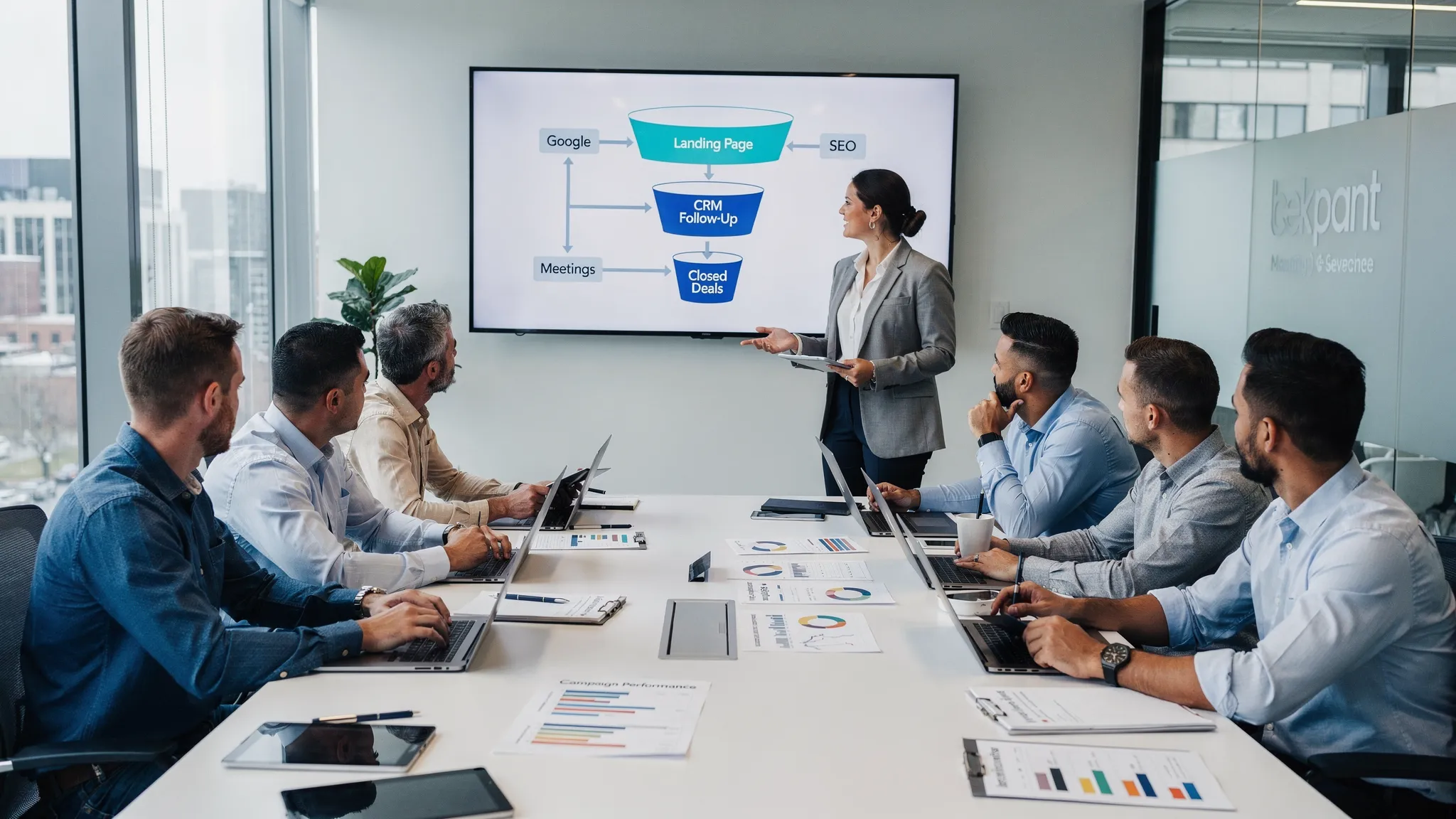
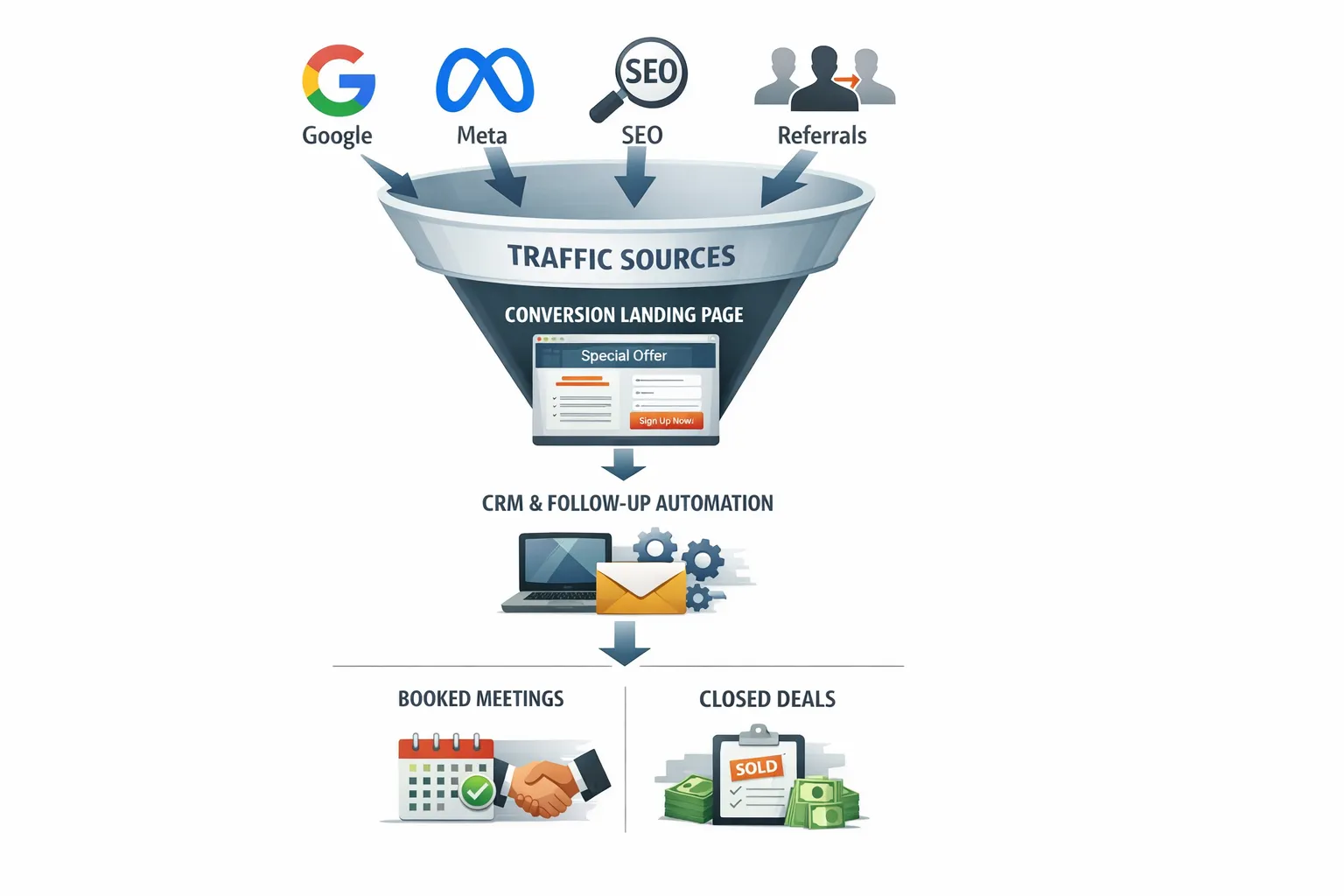
What’s changed heading into 2026 is that the best agencies no longer sell a handful of disconnected deliverables (a few ads, some blog posts, a monthly report). The strongest providers engineer end-to-end growth systems that connect traffic, conversion, and follow-up so the business can scale without chaos.
Below is a clear breakdown of what marketing agencies services typically include in 2026, what “good” looks like, and how to choose the right scope for a local business in Norway or the US.
What “marketing agency services” mean in 2026
In 2026, agencies are increasingly judged on systems and outcomes, not channel activity.
A modern scope often combines:
- Demand capture (Google Search Ads, local SEO, landing pages)
- Demand creation (Meta, content, community, video, thought leadership)
- Conversion infrastructure (tracking, CRM, automations, qualification, routing)
- Experimentation (A/B tests, creative iteration, offer testing)
That shift is driven by:
- Privacy and measurement constraints (less reliable third-party signals, more modeled data)
- AI-powered discovery (buyers using AI assistants and long-tail queries)
- Rising content and ad competition, requiring sharper positioning and better conversion rates
Agencies that can connect these pieces tend to outperform “channel-only” teams.
The core service categories you should expect
1) Strategy, positioning, and offer design
This is where great engagements start, and where weak ones try to skip ahead.
Common inclusions in 2026:
- ICP definition (who you serve, who you don’t)
- Offer packaging (what’s included, pricing logic, guarantees or risk reducers if appropriate)
- Messaging hierarchy (pain points, proof, differentiation, objections)
- Channel strategy (what to run first, what to delay)
- Measurement plan (what counts as a lead, what counts as qualified)
What good looks like: a simple strategy document that ties directly to landing pages, ads, and sales follow-up, not a 60-slide deck that never gets used.
2) Paid media management (Google Ads and Meta Ads)
Paid media is still a primary growth lever for local businesses because it can create pipeline quickly, but it’s more technical and creative than it was a few years ago.
Typical inclusions:
- Account audits and restructure (campaign architecture, match types, negatives, audiences)
- Conversion setup and event QA (what is being tracked, where it breaks)
- Creative testing plan (angles, hooks, formats)
- Budget allocation and pacing
- Landing page alignment (message match)
- Ongoing optimization (bids, search terms, placements, creatives)
What good looks like: the agency can explain, in plain language, how spend turns into outcomes and what levers they’re pulling (creative, offer, targeting, landing page, follow-up).
3) SEO (local SEO and content SEO)
SEO in 2026 is less about publishing “more content” and more about earning trust, coverage, and conversions across the queries that matter.
Common inclusions:
- Technical SEO (crawlability, indexation, Core Web Vitals basics)
- Local SEO (Google Business Profile optimization, citations, review strategy support)
- On-page SEO (service pages that match intent)
- Content planning around real buying questions
- Internal linking and site architecture improvements
- Reporting on leads and assisted conversions, not just rankings
What good looks like: the agency builds or improves pages that drive calls, form submissions, and booked appointments, not traffic that never converts.
4) Conversion rate optimization (CRO) and landing pages
CRO is often the fastest way to improve ROI without increasing ad spend. Many businesses leak value after the click.
Typical inclusions:
- Landing page strategy by intent (high-intent search vs cold social)
- Conversion copywriting (clarity, proof, objections)
- Form optimization (reduce friction, improve lead quality)
- Call tracking and call-focused UX for mobile
- A/B testing roadmap (offers, headlines, layouts)
What good looks like: landing pages are treated like sales assets with iteration cycles, not “one-and-done design projects.”
5) Analytics, tracking, and attribution (the 2026 reality)
Your marketing is only as good as your measurement. In 2026, measurement is more probabilistic than many owners expect, which makes clean setup and consistent definitions essential.
Common inclusions:
- GA4 setup review and event hygiene
- Google Tag Manager configuration
- Ad platform conversion alignment (Google Ads, Meta)
- Call tracking and lead source tracking
- CRM integration basics (so revenue can be tied back to channels)
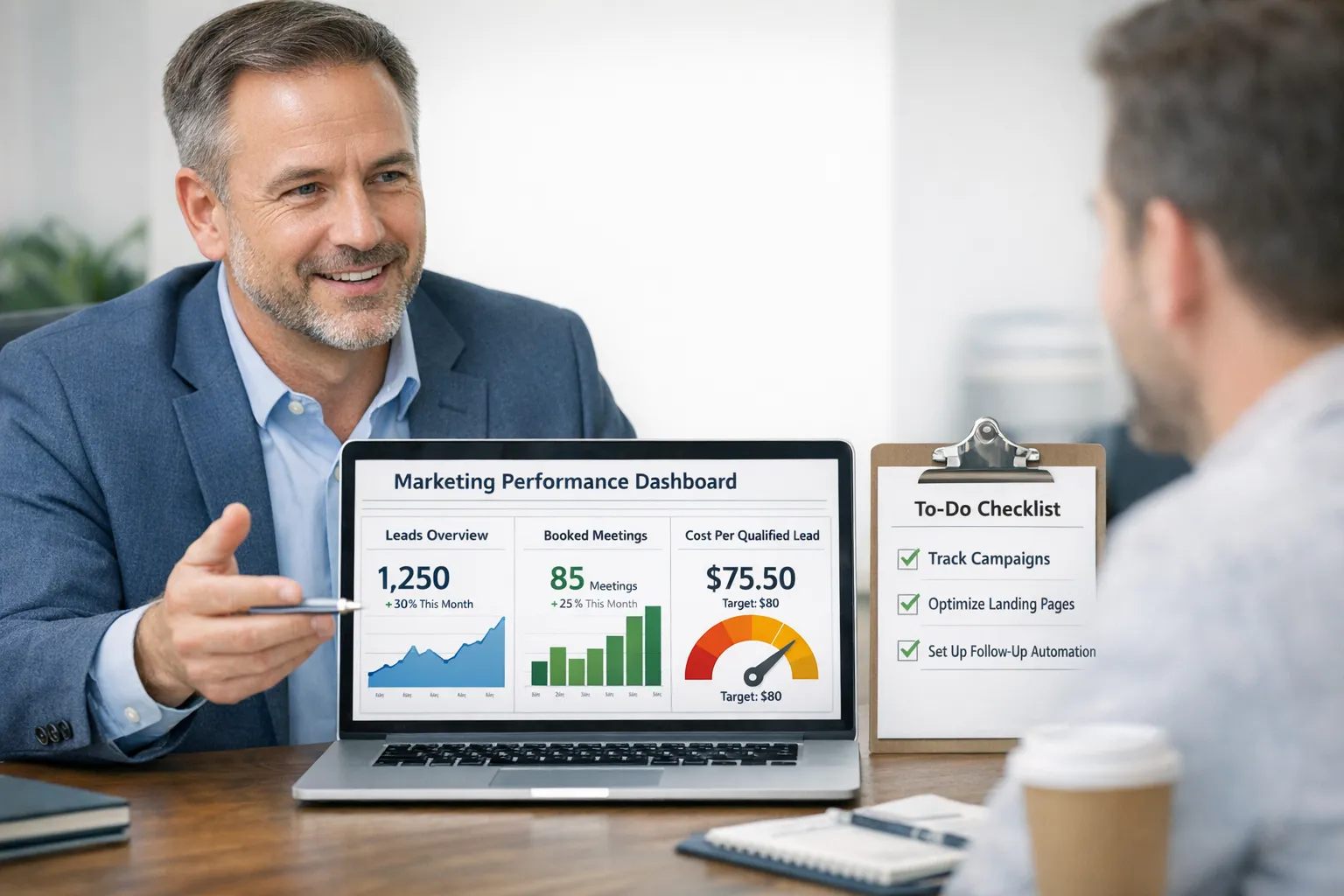
- A reporting layer (dashboards and narrative insights)
If you want a solid reference point for measurement foundations, Google’s overview of Google Analytics 4 is a useful baseline.
What good looks like: reports show business metrics (qualified leads, booked meetings, cost per qualified lead), and the agency can trace how those numbers are produced.
6) Marketing automation and CRM workflows
This is where many agencies still underdeliver, even though it’s often where ROI is won.
Typical inclusions:
- Lead capture routing (form, call, chat)
- Speed-to-lead workflows (instant confirmations and follow-up sequences)
- Qualification logic (questions, scoring, segmentation)
- Calendar routing (only qualified leads book, correct rep assignment)
- No-show reduction (reminders, confirmations)
What good looks like: fewer leads are wasted, sales cycles shorten, and the business can respond quickly without manual effort.
7) Outbound lead generation and meeting booking systems
Outbound has matured. The best agencies focus on relevance, targeting, and deliverability, not volume blasting.
Common inclusions:
- Lead sourcing (data quality, role filters, geo filters)
- Deliverability setup (domains, warmup, infrastructure)
- ICP and messaging development
- Reply handling and follow-up workflows
- Qualification and calendar booking
- Continuous testing (subject lines, angles, offers)
What good looks like: outbound supports pipeline without damaging brand reputation, and the agency can explain how they prevent spam-like behavior.
8) Creative production (ads that can survive 2026 feeds)
Creative has become the targeting. Even with strong optimization, weak creative caps performance.
Typical inclusions:
- Creative direction (angles, proof points, offers)
- Short-form video concepts and scripts
- UGC-style ad frameworks (even for service businesses)
- Iteration cadence (new variants each week or each sprint)
What good looks like: creative testing is systematic, and “why it worked” is documented so wins can be repeated.
9) Website development (when it’s required)
Some agencies include light web work by default, others offer it as a separate project.
Common inclusions:
- New landing pages and templates
- Performance fixes (speed basics, mobile UX)
- Tracking implementation support
- Service page builds for SEO and ads
What good looks like: web changes are prioritized based on conversion impact, not aesthetic preferences.
What’s “new” in 2026 (and should be in your scope)
The fundamentals still matter, but a few shifts have changed what you should demand from an agency.
Stronger emphasis on first-party data and consented tracking
With evolving privacy expectations and regulation, the practical play is building clean first-party data flows: form fills, calls, bookings, email/SMS consent, and CRM hygiene. If your agency can’t connect marketing to follow-up and revenue, you will eventually hit a ceiling.
For US readers, the FTC’s overview of advertising and marketing basics is a helpful reminder that compliance and truth-in-advertising still matter when scaling.
Community and buyer-intent platforms are more measurable than you think
More buying journeys start in public conversations (real questions, real objections). In 2026, agencies are increasingly operationalizing platforms where prospects self-identify through intent.
A practical example is Reddit. If you want to understand why this channel is getting so much attention, this breakdown on why Reddit marketing is the biggest business opportunity for 2026 explains the shift toward long-tail buyer intent and how teams are systematizing engagement.
Faster iteration cycles (weekly, not quarterly)
The best agencies run like product teams:
- Short sprints
- Clear hypotheses
- Rapid creative and landing page iteration
- Tight feedback loops with sales
If your agency updates strategy every 90 days but your market changes every 7, you’re behind.
A quick comparison table: what’s included, and what it’s for
| Service area | Typical deliverables in 2026 | Best for | Primary success metrics |
|---|---|---|---|
| Strategy and messaging | ICP, positioning, offer, measurement plan | Any business scaling spend | Qualified lead rate, close rate, CAC payback |
| Google Ads | Search campaigns, conversion tracking QA, landing page alignment | High-intent demand | Cost per qualified lead, booked calls, ROAS (where applicable) |
| Meta Ads | Creative testing, retargeting, lead capture flows | Demand creation, local awareness | Cost per lead, lead quality, incrementality signals |
| SEO (local + content) | Technical fixes, GBP optimization, service pages, content plan | Sustainable inbound | Calls/forms from organic, local pack visibility |
| CRO + landing pages | Copy, UX, A/B tests, form optimization | Improving ROI without more spend | Conversion rate, cost per booked meeting |
| Automation + CRM | Routing, follow-ups, qualification, calendar workflows | Reducing lead waste | Speed-to-lead, show-up rate, sales productivity |
| Outbound systems | Lead sourcing, deliverability, messaging, reply workflows | B2B pipeline and partnerships | Meetings booked, reply rate, qualified meeting rate |
What you should ask before signing (so you don’t buy “busy work”)
A capable agency should answer these clearly:
- What is your definition of a qualified lead for my business? If they can’t define it, they can’t optimize for it.
- What will you ship in the first 30 days? Look for tangible outputs (tracking fixes, landing pages, campaign builds).
- How do you handle creative and offer testing? “We optimize” is not a plan.
- How will sales follow-up be handled? Even the best lead gen fails with slow response.
- What do you need from us to be successful? The best partners require access, feedback, and decision speed.
What a high-performing first 90 days often looks like
You don’t need a perfect plan. You need a sensible sequence.
Weeks 1 to 2: foundation and clarity
Expect:
- KPI definitions and lead quality criteria
- Tracking QA (forms, calls, booking events)
- ICP and messaging alignment
Weeks 3 to 6: launch and quick-win iteration
Expect:
- Campaign launches or rebuilds
- One or more conversion-focused landing pages
- First creative test batch (especially on Meta)
Weeks 7 to 12: systemization
Expect:
- Better qualification and routing
- Follow-up automation improvements
- A repeatable testing cadence and reporting rhythm
Choosing the right scope for a local business (Norway or the US)
Local businesses usually win by combining one demand capture channel with one conversion system before expanding.
Common “starter stacks” that work in 2026:
- Service business (local intent): Google Ads + landing page + call tracking + review strategy support
- B2B local/regional: outbound meeting booking + conversion-focused landing page + qualification and calendar routing
- Multi-location: local SEO + paid search + centralized reporting + consistent follow-up workflows
Norway-specific note: local language nuance, regional competition, and GDPR-aware processes matter. US-specific note: competition can be higher in many metros, so CRO and speed-to-lead often decide who wins.
Where Kvitberg Marketing fits (if you want systems, not spam)
If your priority is predictable meeting flow and a cleaner path from lead to booked call, Kvitberg Marketing focuses on building outbound and conversion systems that support growth without spamming prospects.
Their work typically sits at the intersection of:
- Outbound client acquisition systems
- Automated meeting booking
- Lead sourcing and deliverability setup
- ICP and messaging development
- Reply and follow-up workflows
- Conversion-focused landing pages
- Qualification and calendar routing
- Performance tracking, A/B testing, and iterative improvements
If you want to evaluate whether a system like that makes sense for your business, start by mapping your current bottleneck (not enough leads, low lead quality, slow follow-up, poor conversion rate). Once the bottleneck is clear, it becomes much easier to choose the right agency scope and avoid paying for activity that doesn’t move revenue.
Learn more about Kvitberg Marketing at kvitbergmarketing.com.