Client Acquisition: Build a Predictable Meeting Pipeline

A predictable meeting pipeline is what turns client acquisition from “hope marketing” into an operating system. Instead of relying on referrals, inconsistent ads, or bursts of posting on social, you build a repeatable process that reliably produces qualified conversations every week.
For local businesses (and local-first B2B teams) in Norway and the US, this is often the difference between a stable calendar and a stressful cycle of feast or famine.
What “predictable” actually means in client acquisition
Predictable does not mean every lead becomes a customer. It means you can:
- Define your ideal prospects clearly
- Reach them consistently through a small number of channels
- Convert a known percentage into replies, meetings, and closed deals
- Improve the conversion rates through testing and iteration
When your pipeline is predictable, growth becomes a math problem, not a mystery.
Start with pipeline math (before you touch tools)
Most teams jump straight to tactics (new ads, new outreach tool, new landing page) without agreeing on the numbers that define success.
Build a simple scorecard around the stages that matter for your business model.
| Stage | What it measures | Why it matters | Common owner |
|---|---|---|---|
| Prospects sourced | New people or companies added to your list | You cannot scale without list volume | Sales/marketing |
| Contactable rate | % of prospects you can reliably reach | Bad data kills deliverability and results | Ops/marketing |
| Reply rate | % who respond (positive or negative) | Early signal that message-market fit exists | Marketing |
| Positive reply rate | % who show interest | Strong proxy for ICP and offer clarity | Sales |
| Meeting booked rate | % who schedule a call | Tests your CTA and routing | Sales |
| Show-up rate | % who attend | Tests confirmation + qualification | Sales |
| Close rate | % who become customers | Tests offer, sales process, and trust | Sales |
If you only track “meetings booked,” you will miss the real bottleneck. A low show-up rate is a different problem than low positive replies.
A realistic example (illustrative, not universal)
Let’s say you want 10 qualified meetings per month.
If your process averages:
- 8% reply rate
- 35% of replies are positive
- 60% of positive replies book
- 75% show-up rate
Then your meeting yield per contacted prospect is:
8% × 35% × 60% × 75% = 1.26% show-up meetings per contacted prospect
To get 10 attended meetings, you need roughly 800 contacted prospects per month (10 / 0.0126).
This is why “just send more outreach” fails when deliverability, targeting, or offer clarity is weak. The math forces you to fix the real constraint.
Foundation: ICP, offer, and proof (the meeting pipeline trifecta)
A predictable meeting pipeline rests on three fundamentals.
1) ICP: stop targeting “anyone who could need this”
Local businesses often widen targeting when pipeline is low. That creates generic messaging, weak replies, and price pressure.
A useful ICP description includes:
- Buyer role (owner, operations manager, clinic director, property manager)
- Business type (e.g., multi-location dental clinics, accounting firms, commercial contractors)
- Trigger events (hiring, expansion, new regulation, competitor entry, seasonal demand)
- Disqualifiers (budget range, geography, service complexity you do not want)
If you can’t describe who you help in one sentence, your pipeline will always be inconsistent.
2) Offer: sell the outcome, not your capabilities
“Google Ads management” is not an offer. “We help electricians in Oslo generate 25 to 40 booked jobs per month without relying on referrals” is closer.
Strong offers usually include:
- A defined outcome
- A defined timeframe (even if it’s a range)
- A defined scope (what’s included and what is not)
- A risk reducer (proof, process, guarantee terms if you genuinely offer one)
3) Proof: reduce perceived risk before the first call
Even when your outreach gets a reply, the prospect is still asking: “Can I trust you?”
Proof can be:
- Short case studies (before/after, constraints, result)
- Clear process (what happens after we talk)
- Testimonials tied to a measurable outcome
- A simple credibility stack (years, niche focus, recognizable client types)
A meeting pipeline collapses when your trust-building assets are missing.
The predictable meeting pipeline blueprint (systems, not hacks)
There are many ways to generate meetings, but most predictable pipelines use the same underlying system:
- Lead sourcing (build lists that match your ICP)
- Deliverability (ensure your messages land)
- Messaging (short, specific, relevant)
- Follow-up workflows (consistent, respectful, persistent)
- Conversion path (landing page or one-pager that matches the message)
- Qualification + routing (right prospects book the right time slot)
- Tracking + iteration (weekly improvements)
Below is how to build each part without turning into a spam machine.
Step 1: Lead sourcing that does not poison your results
Bad lists create fake “data.” You think your messaging is failing, but in reality you’re targeting the wrong people or using low-quality contacts.
For local businesses, prioritize sources that reflect real-world relevance:
- Local business directories and association lists
- Maps-based research (service area fit)
- Industry-specific directories (clinics, property managers, manufacturers)
- Event attendee lists (when used responsibly and legally)
The goal is not maximum volume. The goal is high ICP density.
A practical rule: if you cannot explain why each company is on your list, your targeting is too loose.
Step 2: Deliverability and trust signals (the hidden limiter)
If you use email for outbound client acquisition, deliverability is a core part of the system. Even strong copy does nothing if you land in spam.
Key principles:
- Use proper domain and mailbox setup (SPF, DKIM, DMARC)
- Avoid sending from your primary domain when scaling outbound
- Ramp volume gradually and keep sending patterns consistent
- Keep messages plain and human (too many links and tracking can hurt)
Also, respect privacy and marketing laws relevant to your market (GDPR considerations in Norway and EU contexts, and applicable US rules). If you are unsure, get counsel. A predictable pipeline is built on trust and compliance, not shortcuts.
Step 3: Messaging that earns replies (especially for local services)
Most outbound fails because it asks too much too soon.
Your first message is not a proposal. It’s a relevance test.
High-performing outbound messaging typically has:
- A specific reason you chose them
- One problem hypothesis (based on their context)
- A simple, low-friction call to action
Examples of relevant “reasons” for local businesses:
- They serve a specific area you specialize in
- They have multiple locations (higher LTV, more operational complexity)
- They are hiring for roles that signal growth
- Their current lead flow is clearly inconsistent (visible gaps in ads, reviews, website conversion basics)
Avoid vague personalization (“Loved your website!”). It reads like automation because it usually is.
Step 4: Follow-up workflows that feel professional, not desperate
Most qualified prospects do not respond to the first message. They are busy, skeptical, or they saw it at the wrong time.
The key is to build a follow-up sequence that:
- Adds a small amount of new information
- Stays concise
- Makes opting out easy
- Stops when there is clear disinterest
Follow-ups should create clarity, not pressure.
Step 5: The conversion path (what happens after they click)
If your message gets interest, the next step must feel consistent.
For many local businesses, a high-converting conversion path is:
- A short landing page (or one-page site section) aligned to the outreach promise
- One clear CTA (book a call, request quote, or “see if we’re a fit”)
- A short proof section (2 to 4 proof points, not a wall of logos)
- A simple explanation of the process
If the prospect clicks and sees a generic homepage, you introduce friction and confusion.
Step 6: Qualification and calendar routing (protect your time)
A predictable meeting pipeline is not just about more meetings. It’s about the right meetings.
Add lightweight qualification before the calendar:
- Geography/service area
- Ideal budget band (you can ask ranges without sounding pushy)
- Timeline and urgency
- Decision-maker involvement
Then route:
- Hot leads to near-term slots
- Lower urgency leads to later slots
- Poor-fit leads to a polite exit or referral path
This protects your calendar and increases close rate.
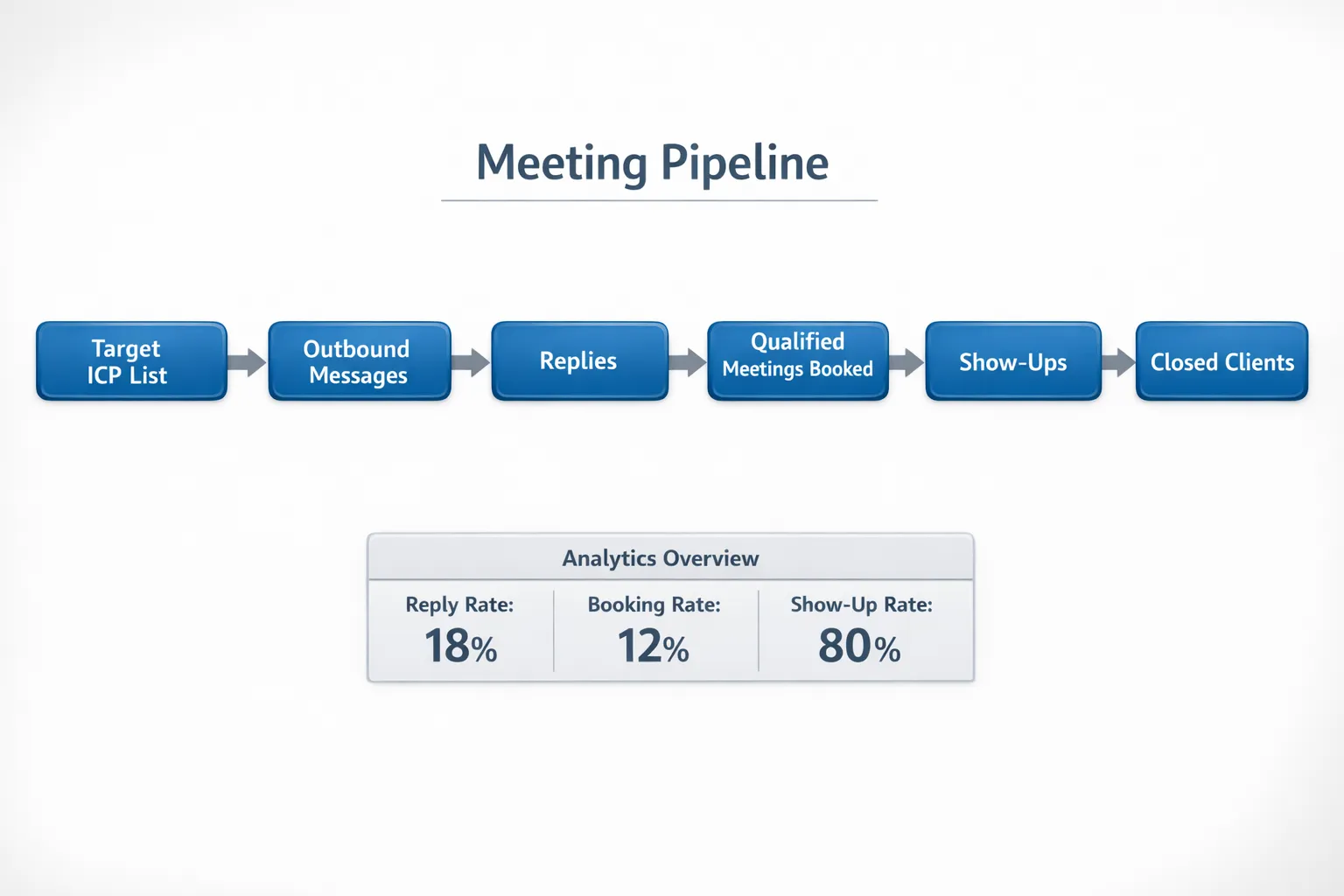
Step 7: Tracking and iteration (the weekly operating rhythm)
Predictability comes from continuous improvement. You do not need complex dashboards to start, but you do need consistency.
Set a weekly review where you check:
- Volume: prospects sourced and contacted
- Quality: bounce rate, contactable rate
- Signal: reply rate and positive reply rate
- Conversion: booked rate and show-up rate
Then decide one change to test in the next week:
- A new ICP slice (narrower, not broader)
- A new opening line (different “reason”)
- A different CTA (15-minute fit check vs 30-minute consult)
- A revised landing page headline to match outreach wording
Avoid changing five things at once. You will not know what worked.
Where predictable pipelines break (and how to fix them)
You get replies, but not bookings
This is usually:
- A weak CTA (too big of an ask)
- Confusing next step (no clear link between message and calendar)
- Lack of proof (they are curious but not confident)
Fix by tightening the call-to-action and aligning the landing page or one-pager with the message.
You book meetings, but they do not show
This is usually:
- Poor qualification (they booked out of curiosity)
- Weak confirmation flow
- The meeting positioning is off (it feels like a sales ambush)
Fix by adding a short pre-call question, clarifying the agenda, and ensuring the prospect knows what decision the call is meant to support.
You can’t scale volume without deliverability issues
This is usually:
- Domain and inbox setup problems
- Unclean lists
- Sending behavior that triggers filtering
Fix by treating deliverability as infrastructure, not an afterthought.
Don’t ignore compliance and trust as you scale
For some industries, “trust” is not just branding. It’s operational. If your client acquisition targets regulated environments (health, finance, legal, vendor risk-heavy supply chains), prospects may expect strong documentation and governance.
In those cases, operational tools can support your sales motion. For example, an AI-powered compliance management platform like Naltilia can help teams reduce time spent on compliance work while improving client trust signals, which can indirectly improve conversion rates in compliance-sensitive deals.
When it makes sense to use a done-with-you outbound system
If you have a solid service and you know you can fulfill, but your meeting flow is inconsistent, the biggest leverage is usually building a complete system rather than patching tactics.
Kvitberg Marketing builds outbound client acquisition systems designed to book qualified meetings without spamming prospects, including lead sourcing, deliverability setup, ICP and messaging development, reply and follow-up workflows, conversion-focused landing pages, qualification and calendar routing, and performance tracking with ongoing optimization.
The result you’re aiming for is simple: a pipeline you can predict, measure, and improve every week, whether you’re a local business in Norway or the US, or a B2B team selling a high-trust service.