Business and Marketing Alignment: Build a Simple Revenue System

Most local businesses do not have a “marketing problem”. They have an alignment problem.
Marketing is trying to create demand (traffic, calls, forms, walk-ins). The business has to convert that demand into revenue (quotes sent, jobs booked, invoices paid, repeat customers). When those two sides are not designed to work together, you get familiar symptoms:
- Ads bring leads that do not fit.
- SEO brings traffic that never contacts you.
- Sales says “these leads are bad”, marketing says “we delivered leads”.
- Revenue becomes unpredictable, even when you spend more.
Business and marketing alignment fixes this by turning “random marketing activity” into a simple revenue system that your team can run every week.
What “business and marketing alignment” really means
Alignment is not a meeting. It is a shared operating system.
When business and marketing are aligned, everyone can answer these questions the same way:
- Who is our best customer (and who are we not trying to win)?
- What problem do we solve, and what do we want people to do next?
- What counts as a qualified lead?
- What happens to a lead in the first 5 minutes, 5 hours, and 5 days?
- Which numbers tell us the truth about revenue, not just “activity”?
For local businesses in Norway and the US, alignment is especially important because your best channels (Google Search, local SEO, referrals, Meta retargeting) are high intent. People are already looking for a solution. Your job is to capture that intent, respond fast, and close cleanly.
The simple revenue system (4 parts)
A simple revenue system is the smallest set of components that reliably turns attention into booked work.
1) Offer clarity (what you sell, to whom, and why you win)
If the offer is vague, marketing has to “guess” which message will work, and sales has to “educate” every lead from scratch.
Offer clarity does not mean you need a fancy brand deck. For most local businesses, it means:
- A primary service (your main money-maker).
- A clear service area (cities, counties, or radius).
- A clear “best-fit” customer (so you stop attracting the wrong jobs).
- A proof-based reason to choose you (examples: response speed, specialization, warranty, certifications, niche expertise).
A simple test: if someone asked “Why should I pick you instead of the top 3 competitors in Google?”, could your team answer in one sentence?
2) Demand capture (website and landing pages that convert)
Alignment shows up on the page.
If your marketing is driving clicks to a page that does not match the intent, conversions collapse. For example:
- Someone searches “emergency plumber near me” and lands on a generic homepage.
- Someone clicks an ad for “kitchen remodeling estimate” and the page has no estimate process.
A conversion-friendly page for local services usually needs:
- A headline that matches the search or ad promise.
- One primary call to action (call, book, request quote).
- Trust elements (reviews, licenses, photos, guarantees, case results).
- A short form (only what you truly need).
- Fast mobile performance.
If you are running Google Search Ads, you should also set up conversion tracking so you can optimize toward outcomes, not clicks. Google’s own guide is a solid starting point: Set up conversion tracking.
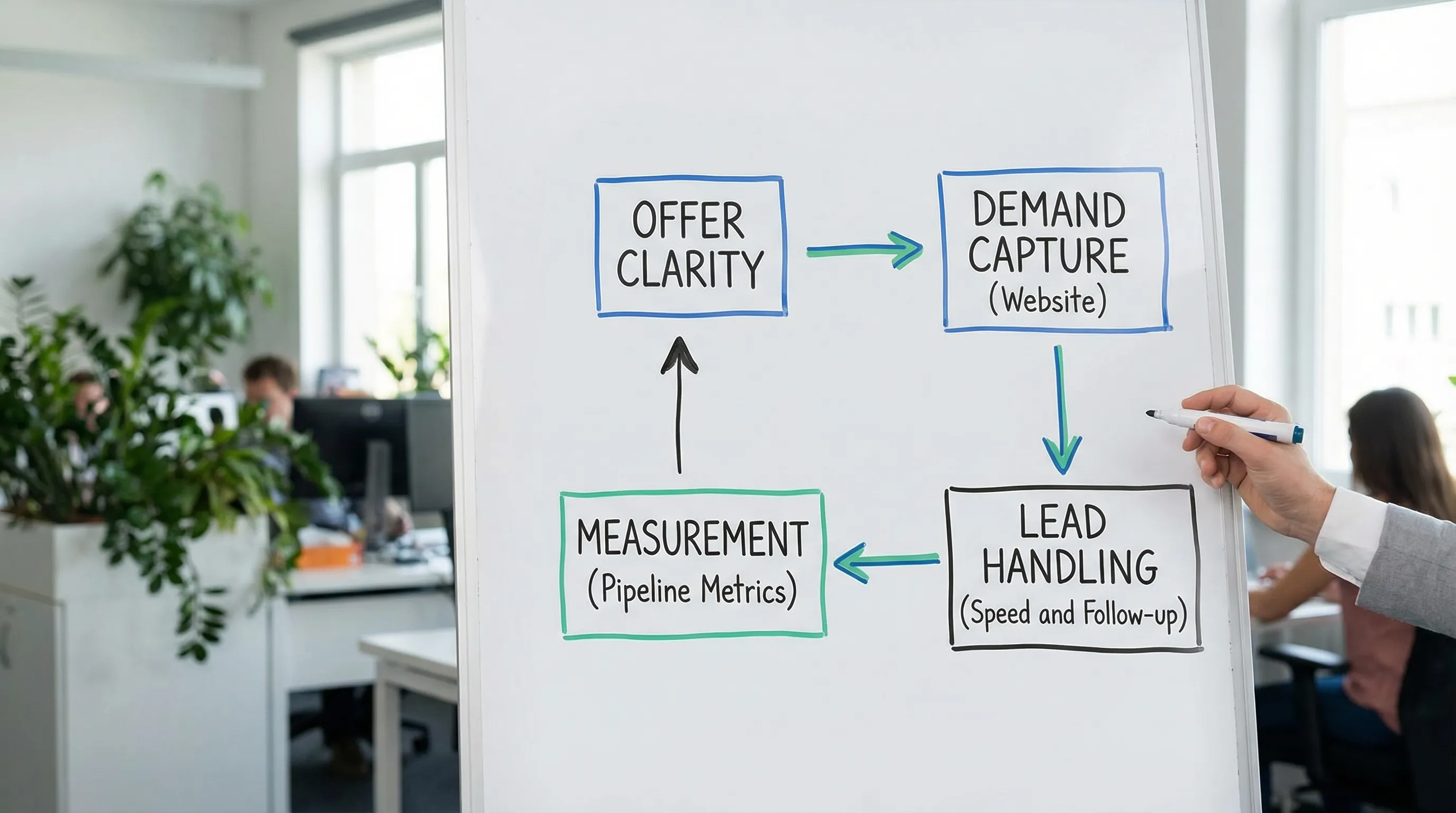
3) Lead handling (speed, follow-up, and qualification)
This is where most “lead gen” breaks.
Marketing can generate demand, but revenue is created (or lost) in the first minutes after the lead comes in. For high-intent local leads, speed matters because prospects often contact multiple providers.
Alignment means marketing and the business agree on:
- What a “qualified lead” is (budget, service area, urgency, job type).
- The response standard (example: first response within 5 to 15 minutes during business hours).
- The follow-up cadence (how many attempts, and through which channels).
- The handoff steps (who calls, who sends the quote, who books).
If you only do one improvement this month, do this: define your first-response process and make it repeatable.
4) Measurement (one view of truth from click to cash)
Misalignment thrives in messy measurement.
Marketing reports impressions, clicks, CTR. Sales reports “busy phones” or “not enough good leads”. The owner sees bank balance changes and tries to guess what caused them.
A simple revenue system uses a shared set of metrics that connect marketing to revenue.
Here is a practical way to structure it.
| Funnel stage | What it answers | The metric to track | Who owns it |
|---|---|---|---|
| Demand | Are we being found by the right people? | Calls, forms, bookings (not just clicks) | Marketing |
| Lead quality | Are these the right jobs? | Qualified lead rate | Marketing + Sales |
| Speed to lead | Are we responding fast enough? | Median first response time | Sales/Operations |
| Conversion | Are we closing? | Close rate, average order value | Sales/Owner |
| Payback | Is this profitable? | Cost per booked job, gross margin per job | Owner |
You do not need a complex BI setup to start. You need consistent definitions and a weekly routine.
The alignment playbook (built for small teams)
Most local businesses do not have separate departments. The “team” might be the owner, an office manager, and one person handling marketing. That is a strength if you keep the system simple.
Define a shared “lead” vocabulary
Write down these definitions in one place:
- Lead: a new contact with intent (call, form, booking).
- Qualified lead: meets your criteria (service area, job type, minimum budget, timeline).
- Booked job: scheduled and confirmed.
- Won revenue: invoiced (or collected, depending on your accounting preference).
When definitions are clear, you can stop debating feelings and start improving conversion.
Build a one-page funnel map
Your funnel is the path from “search” to “sale”. For local businesses, a simple version looks like:
Traffic source (Google, Meta, referrals) → Page → Call/form → Response → Quote → Booked job
When something breaks, you can locate the bottleneck.
Create one primary conversion path per core service
If you try to sell everything on every page, your conversion rate usually drops.
A better approach is:
- One core service page (or landing page) per high-value service.
- One primary call to action.
- One clear next step (book, request quote, call now).
This is especially helpful for Google Search Ads, where intent is specific and landing page relevance affects performance.
Install “handoff rules” (so leads do not get lost)
Alignment requires handoff rules, even if the same person is doing multiple roles.
Good handoff rules are boring, which is the point. Examples:
- Every form submission triggers an immediate confirmation (email or SMS) and creates a task to call.
- Missed calls get a call-back within a set window.
- Quotes go out the same day whenever possible.
- Every unclosed quote gets a follow-up touch.
If you use automation, keep it human in tone and focused on speed and clarity.
Run a 30-minute weekly revenue standup
Keep it short, consistent, and based on the same 6 to 10 numbers each week.
A useful agenda:
- Leads received (calls, forms, bookings)
- Qualified lead rate
- First response time
- Quotes sent
- Jobs booked
- Cost per booked job (if running ads)
- Notes: top objections, common questions, lead quality issues
This meeting is where business and marketing alignment becomes real.
A simple scorecard you can copy
Use this checklist as a self-audit. If you answer “no” to any item, you have a clear next action.
| Area | “Aligned” looks like | Quick self-check |
|---|---|---|
| Offer | Clear best-fit customer and service focus | Can we describe our ideal job in one sentence? |
| Messaging | Pages match search and ad intent | Does the landing page headline mirror the ad/search intent? |
| Conversion | One obvious next step | Is there one primary CTA above the fold on mobile? |
| Lead handling | Speed and follow-up are defined | Do we respond within a set time window every day? |
| Tracking | Outcomes are tracked | Do we track calls/forms/bookings as conversions? |
| Feedback loop | Sales insights improve marketing | Do objections and FAQs get added to pages and ads monthly? |
Common alignment mistakes (and the fix)
Mistake: Measuring “marketing performance” without sales outcomes
If you only measure traffic and clicks, you will optimize for cheap volume.
Fix: tie campaigns to conversions (calls, forms, bookings) and review lead quality weekly.
Mistake: Sending all traffic to the homepage
Homepages are often designed to introduce the business, not to convert a specific intent.
Fix: build dedicated service pages or landing pages that match the exact query and promise.
Mistake: Treating lead follow-up as optional
Leads decay quickly. If you respond slowly, you effectively pay to advertise for competitors.
Fix: define response standards and automate the first acknowledgment if needed.
Mistake: No “closed-loop” feedback
Marketing rarely hears why deals are lost, so the same problems repeat.
Fix: track lost reasons (too expensive, out of area, wrong service, timing) and adjust targeting, copy, and qualification.
How this fits local SEO and Google Ads in 2026
Local search behavior continues to reward relevance and trust. Whether you are in Norway or the US, the fundamentals are consistent:
- People search with high intent (service + location + urgency).
- They compare quickly (reviews, photos, speed of response).
- They choose the path of least friction (fast site, clear CTA, easy booking).
That means alignment is not “extra”. It is the foundation.
If you are investing in SEO, your content should not just rank, it should convert and qualify. If you are investing in Google Search Ads, your landing pages and your follow-up process are part of ad performance, because they determine whether clicks turn into revenue.

Frequently Asked Questions
What is business and marketing alignment? Business and marketing alignment means your offer, messaging, lead handling, and measurement are designed as one system, so marketing activity reliably produces revenue outcomes.
What is a “simple revenue system” for a local business? It is a repeatable setup that connects offer clarity, a converting website or landing page, fast lead response, and basic tracking from lead to booked job.
Which matters more, more leads or better follow-up? For many local businesses, improving response time and follow-up increases booked jobs faster than increasing ad spend, because it captures value from leads you already generate.
Do I need a CRM to align marketing and sales? Not always. A CRM can help, but alignment starts with clear definitions, a consistent follow-up process, and tracking conversions. Many businesses can begin with simple tools and upgrade later.
How do I know if my website is hurting conversions? If you have traffic but low calls/forms, unclear calls to action, slow mobile load, or pages that do not match what people searched for, your website is likely a conversion bottleneck.
Want a revenue system without guessing? Start with a finished website
If your current website is outdated, slow, or not built to convert, alignment becomes harder because every campaign pushes traffic into a leaky bucket.
Kvitberg Marketing builds high-quality, SEO-optimized websites for local businesses for free, with no upfront commitment. You submit an inquiry, we deliver a fully finished website, then you decide whether you want to buy after seeing the result.
If you want, we can also support growth after the site is live with optional visibility services like SEO campaigns and Google Search Ads management.
Explore Kvitberg Marketing and request your free website build at kvitbergmarketing.com.