B2B Marketing Fundamentals: A Practical Guide for 2026

B2B marketing in 2026 is less about “getting more leads” and more about building a system that creates trust, captures demand when it exists, and converts buying committees over time. Buyers research anonymously, compare vendors quickly, and involve more stakeholders than most small teams expect. If you are a local B2B business (consulting, trades, SaaS, professional services, manufacturing, logistics), fundamentals still win, but the bar for clarity, proof, and measurement is higher.
This guide lays out a practical, modern B2B marketing foundation you can implement without enterprise tooling.
What “B2B marketing fundamentals” means in 2026
B2B marketing fundamentals are the repeatable building blocks that help you:
- Target the right companies (not “everyone who could buy”).
- Explain your value fast (in plain language, backed by proof).
- Show up in high-intent moments (especially search and referrals).
- Capture and nurture demand (because most buyers are not ready today).
- Track what works (despite privacy changes and longer sales cycles).
In 2026, the biggest shift is not a new channel. It is that attention and trust are harder to earn, while AI has made “average content” abundant. Fundamentals help you avoid being indistinguishable.
Step 1: Start with an ICP you can actually execute on
Most B2B marketing underperforms because the targeting is vague. Your Ideal Customer Profile (ICP) should be specific enough that you can build landing pages, ads, and outbound lists without guessing.
A useful ICP definition includes:
- Firmographics: industry, size, geography (for example: “Oslo-area companies with 10 to 200 employees” or “US HVAC distributors”).
- Trigger events: hiring, expansion, compliance changes, new location, new funding, new leadership.
- Core problem: what pain exists before they talk to you.
- Success outcome: what changes after they buy.
- Disqualifiers: who you do not want (low budget, wrong tech stack, unrealistic timelines).
If you struggle here, simplify: pick one vertical and one primary use case for the next quarter. A narrow message that converts beats a broad message that gets ignored.
Step 2: Positioning and messaging that survives “AI sameness”
In 2026, many competitors can generate decent-looking web pages in minutes. Your differentiation must be grounded in reality and easy to verify.
A strong B2B message stack has three layers:
Category and outcome
State what you do and the outcome in one sentence.
Example pattern: “We help [ICP] achieve [measurable outcome] by solving [specific constraint].”
Proof
Proof is the currency of B2B. Use:
- Short case studies with specific outcomes and context.
- Before/after workflows.
- Certifications, partnerships, and credible logos (only if real and current).
- Clear process steps (so buyers can predict what working with you feels like).
Risk reversal
Your buyer is thinking: “What if this fails and I look bad internally?” Reduce that perceived risk through clear scope, timelines, and expectations.
Step 3: Build your B2B funnel as a system (not isolated campaigns)
A practical B2B funnel is not just awareness, consideration, conversion. It is a set of touchpoints that work together.
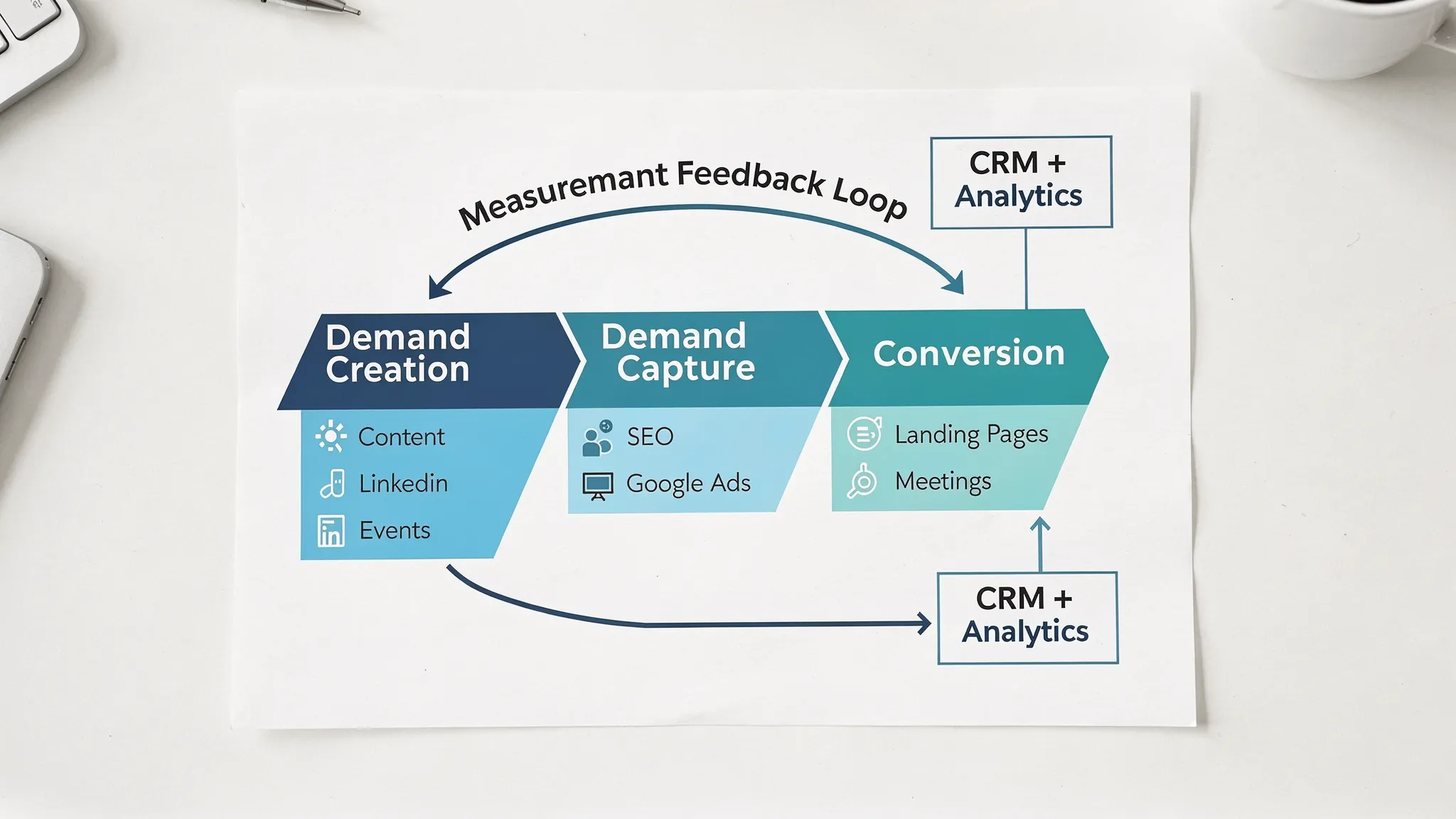
A simple system looks like this:
- Demand capture: High-intent search, retargeting, partner referrals.
- Demand creation: Thought leadership, webinars, LinkedIn content, targeted outbound, events.
- Conversion: Landing pages, offers, meetings, proposals.
- Expansion: Upsells, renewals, referrals.
What changes in 2026 is measurement and buyer behavior: more research happens off-site (communities, private chats, AI summaries). That means your site and sales process must close the “trust gap” quickly.
Step 4: Choose channels based on intent, not popularity
A common mistake is copying what big brands do. Local B2B teams win by choosing channels that match their cycle and budget.
Channel roles in a modern B2B mix
| Channel | Best for | Strength | Watch-outs in 2026 |
|---|---|---|---|
| SEO | Capturing existing demand | Compounds over time, high trust | Requires clarity, technical hygiene, and patience |
| Google Search Ads | Immediate high-intent traffic | Fast learning, scalable | Needs tight tracking and strong landing pages |
| LinkedIn (organic + paid) | Reaching roles, shaping demand | Great for committee selling | Expensive paid CPMs, needs strong creative |
| Email nurturing | Moving deals forward over time | Low cost, high leverage | Needs clean lists and real value |
| Partnerships/referrals | High trust leads | Often best close rates | Requires relationship work, co-marketing |
For fundamentals, prioritize one capture channel (SEO or search ads) plus one creation channel (often LinkedIn or partnerships). Add more only after you can measure and maintain quality.
If you are investing in SEO, Google’s own guidance on creating helpful, reliable content is worth internalizing: Google Search Central.
Step 5: Your website is your primary salesperson
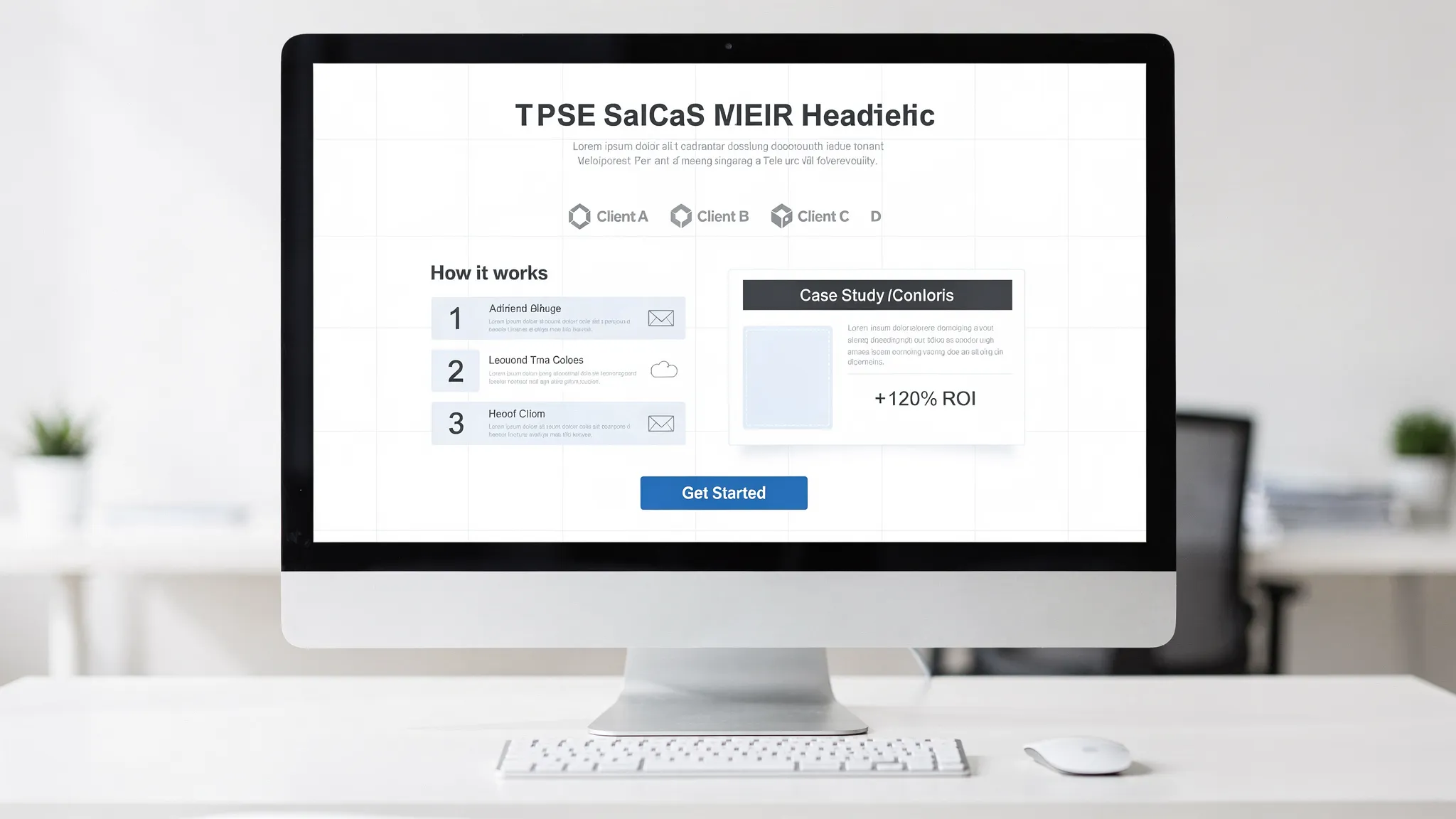
In B2B, the website is not a brochure. It is a qualification and conversion tool that supports the entire buying committee.
The 2026 B2B website checklist (practical)
| Page element | Why it matters | What “good” looks like |
|---|---|---|
| Clear above-the-fold positioning | Reduces bounce, sets context | “Who it’s for + what you deliver + how you do it” |
| Proof near key claims | Builds trust fast | Case studies, metrics, testimonials, certifications |
| Single primary CTA | Reduces confusion | “Book a call” or “Get a quote” with clear next step |
| Fast load and mobile usability | Impacts conversion and SEO | Clean layout, lightweight assets, readable on mobile |
| Service pages by use case | Matches search intent | One page per core service or problem, not one generic page |
| Contact friction is appropriate | Protects your time | Forms that qualify without being 15 fields long |
If you serve local markets (Norway or specific US regions), “local proof” is powerful: local case studies, local industries, and clear service areas.
Step 6: Content that supports real buying decisions
B2B content in 2026 must do more than “rank on Google.” It should reduce perceived risk and help buyers justify a decision internally.
A balanced B2B content library includes:
- Problem education: what causes the issue, what it costs, what “good” looks like.
- Solution comparison: approaches, trade-offs, in-house vs agency, DIY vs done-for-you.
- Use-case pages: “for [industry]” or “for [role]” pages with specific workflows.
- Proof content: case studies, teardown posts, before/after, process explainers.
- Enablement content: implementation guides, checklists, onboarding expectations.
If LinkedIn is part of your mix, follow research-backed B2B thinking from sources like the LinkedIn B2B Institute, especially around brand building and mental availability.
Step 7: Measurement fundamentals (without pretending attribution is perfect)
In B2B, “last click” rarely reflects reality. People may visit five times, compare vendors, talk to peers, then finally submit a form after a branded search.
Your goal is not perfect attribution. Your goal is decision-grade measurement.
Core B2B metrics to track
| Funnel stage | Primary goal | Metrics that matter | Tools where it usually lives |
|---|---|---|---|
| Awareness / creation | Be remembered by the right people | Reach in ICP, engagement quality, direct traffic trends | LinkedIn analytics, GA4 |
| Demand capture | Turn intent into visits | Non-branded clicks, impression share, CTR, rankings | Google Ads, Search Console |
| Conversion | Turn visits into leads | CVR by landing page, cost per lead, meeting rate | GA4, ad platforms, CRM |
| Pipeline | Turn leads into revenue | MQL to SQL, win rate, sales cycle length, CAC | CRM |
| Retention / expansion | Increase LTV | Renewal rate, expansion revenue, referrals | CRM / billing |
Tracking basics you should implement
- A CRM is mandatory (even a simple one). If revenue is not tied back to a source, you will optimize for the wrong thing.
- Track the first meaningful conversion, usually a booked meeting or qualified inquiry, not just page views.
- Import offline conversions into Google Ads when possible, so bidding aligns with qualified outcomes. Google’s documentation is a good starting point: About offline conversion tracking.
- Expect more “unknown” traffic as privacy controls evolve. Use a mix of self-reported attribution (a “How did you hear about us?” field) plus platform data.
For local B2B teams, the biggest measurement unlock is often not a new dashboard. It is simply consistent lifecycle stages (lead, qualified, meeting booked, proposal sent, closed won) and enforcing them.
Step 8: Sales and marketing alignment (the hidden multiplier)
If you only fix one operational issue, fix lead follow-up and qualification.
Agree on:
- Lead definitions: what counts as qualified.
- Speed to lead: how fast someone follows up.
- Feedback loop: sales marks lead quality, marketing reviews weekly.
- Common language: industries, deal size, and reasons for loss.
A practical tip: record 10 sales calls (with permission) and extract the repeated objections and phrases buyers use. Those become your best landing page headlines and ad copy.
Step 9: A practical 90-day B2B marketing plan for 2026
You do not need to do everything at once. You need a sequence.
Days 1 to 15: Foundation
- Define ICP, top 2 to 3 use cases, and key differentiators.
- Audit your website for clarity, proof, and one primary conversion path.
- Set up or clean CRM stages and confirm what “qualified” means.
Days 16 to 45: Capture demand
- Publish or improve core service pages based on real search intent.
- Launch a small Google Search campaign focused on high-intent queries (or improve existing campaigns).
- Create one landing page per primary offer, not a one-page-fits-all approach.
Days 46 to 90: Build trust and pipeline
- Publish 2 to 4 decision-support pieces (comparisons, case studies, implementation guides).
- Start a simple LinkedIn cadence that speaks to one role and one problem.
- Review pipeline weekly and cut what drives low-quality leads.
The goal after 90 days is not “we solved marketing.” It is: you have a repeatable engine, early signals, and a clear next set of experiments.
Where Kvitberg Marketing fits (if you want a faster start)
If your bottleneck is simply not having a high-quality site that is built to convert, Kvitberg Marketing offers a different approach: a pre-built, professional, SEO-optimized website created for local businesses, free with no upfront commitment. You review the finished site in a short walkthrough meeting, and you only decide to buy if you like the result.
Once the foundation is in place, optional growth support can include SEO campaigns and Google Search Ads management, depending on your goals.
You can learn more or submit an inquiry at Kvitberg Marketing.