Automated Marketing Services: What’s Included and What’s Not

Most “automation” pitches sound the same: more leads, less work, smarter ads. In reality, automated marketing services vary widely in what you actually receive, what you still need to do internally, and what costs sit outside the provider’s fee.
This guide breaks down what is typically included (and excluded), so you can compare vendors, scope projects cleanly, and avoid paying for automation that does not move revenue.
What “automated marketing services” usually means
Automated marketing services combine two things:
- Marketing execution (ads, SEO, email, landing pages, reporting).
- Automation infrastructure (tracking, integrations, workflows, rules, and systems that reduce manual work).
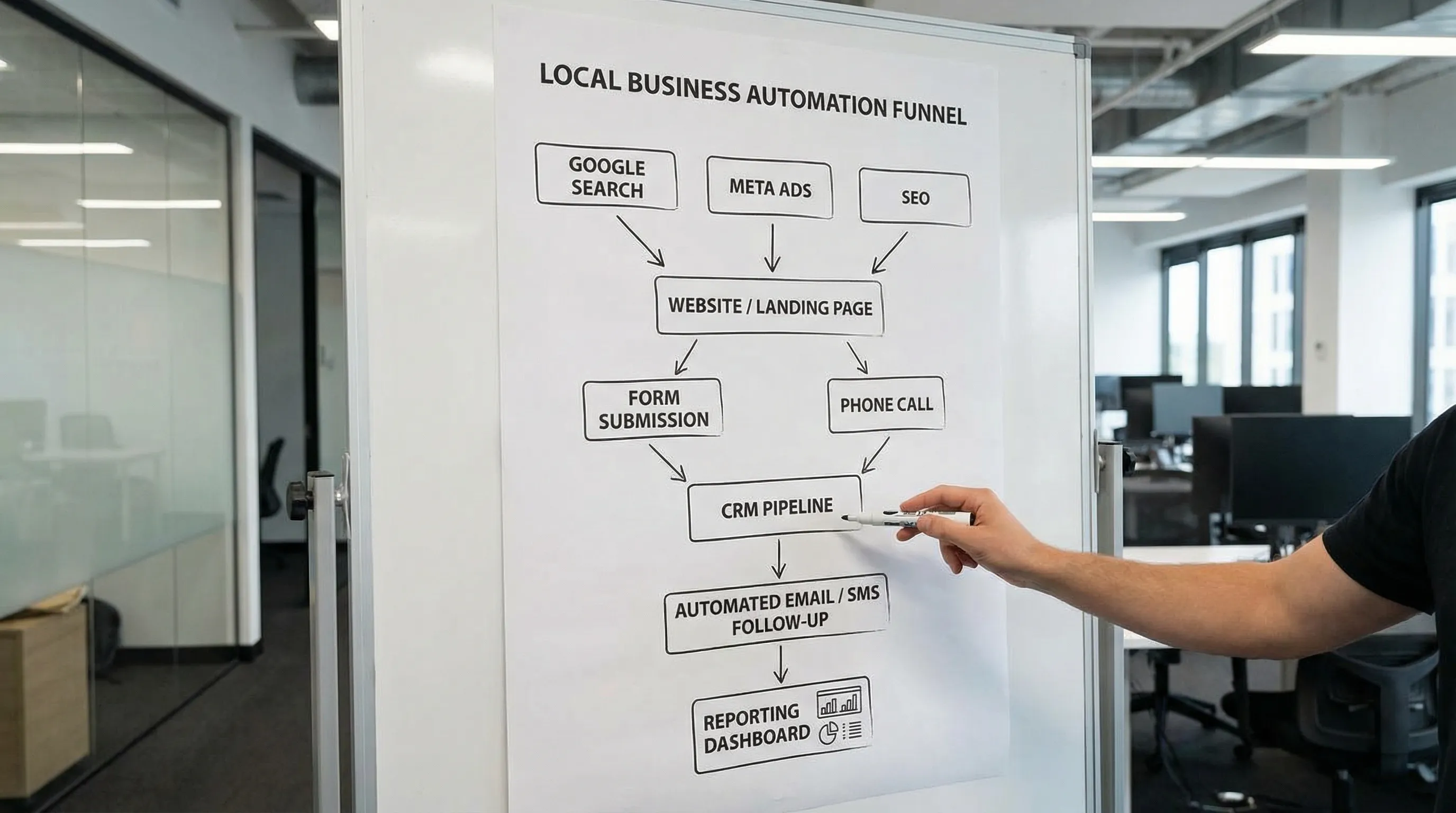
A good provider is not just “setting up tools.” They are engineering a repeatable system: traffic in, leads captured, follow-up triggered, results measured, and feedback loops that improve performance.
A weak provider is mostly delivering software logins and templated sequences with little measurement, little iteration, and unclear ownership.
What’s typically included in automated marketing services
Exact deliverables differ by agency, but most serious offers include the building blocks below.
1) Discovery, goals, and funnel mapping (light strategy)
You should expect some form of alignment on:
- Target customer and service area (for local businesses, this is often geo-specific)
- Primary conversion actions (calls, form fills, bookings)
- Offer positioning that matches intent (emergency service, same-day slots, free consult, etc.)
- A simple funnel map (ad or search query → landing page → lead capture → follow-up)
This is rarely deep brand strategy. It is practical scoping so the automation has something measurable to optimize.
2) Tracking and measurement foundations
If tracking is not in the scope, automation becomes guesswork.
Common inclusions:
- Conversion tracking setup (forms, calls, bookings)
- Google Analytics configuration and key events
- Google Ads and/or Meta Ads pixel configuration (where relevant)
- Basic attribution hygiene (UTM standards, naming conventions)
For Google Ads specifically, it is worth reading Google’s overview of how conversion tracking works and what it requires, because your “included” setup will still depend on your website and consent configuration: About conversion tracking.
3) Lead capture assets (landing pages and forms)
Automation needs reliable entry points.
Depending on the provider, this may include:
- One or more landing pages designed for conversion
- Embedded forms connected to a CRM or email platform
- Call tracking numbers (sometimes handled via a third-party tool)
If your vendor also builds websites, this portion may be broader. For example, Kvitberg Marketing offers pre-built, SEO-optimized websites for local businesses, delivered first with no upfront commitment, followed by a walkthrough where you decide whether to purchase the finished site. (Growth services like SEO campaigns and Google Search Ads are optional add-ons.)
4) CRM and pipeline basics (or at least integration)
A common “automation” deliverable is connecting lead sources to a system that can track status.
Typical components:
- Connecting forms to a CRM (or a lightweight lead inbox)
- Pipeline stages (new lead, contacted, booked, won, lost)
- Notifications to your team (email, Slack, SMS depending on tools)
Some providers will implement this inside your existing CRM. Others will set up a new one. Either is fine, as long as ownership and admin access are clear.
5) Automated follow-up (email and SMS workflows)
This is the most recognizable part of marketing automation.
Common inclusions:
- A short lead nurture sequence (for leads who are not ready today)
- Missed-call text-back (for service businesses that rely on calls)
- Appointment reminders
- Re-engagement campaigns for older leads
You should also expect basic segmentation rules like “send different follow-up if the lead requested Service A vs Service B.”
6) Paid media management with automation layers
If ads are part of the package, automation may show up as:
- Automated rules (pause underperformers, increase budget within constraints)
- Scripted checks (broken URLs, disapproved ads)
- Negative keyword maintenance workflows (for search)
- Retargeting audiences and exclusions (where applicable)
Important: these automations reduce manual work, but they do not replace weekly decision-making. Someone still needs to interpret lead quality, cost per lead, and conversion rates.
7) SEO systems (process automation, not “SEO on autopilot”)
SEO can be systematized, but not fully automated.
What’s commonly included under SEO-related automation:
- Technical SEO baseline checks (indexing, sitemaps, core on-page issues)
- Templates and SOPs for publishing pages consistently
- Reporting that tracks rankings, clicks, and conversions
What is not realistic: “Set it and forget it SEO.” Content, local relevance, and authority still require human input and business knowledge.
8) Reporting and accountability
At minimum, expect recurring performance reporting tied to the original goals:
- Leads generated (and by source)
- Cost per lead (for paid)
- Conversion rate (landing pages/forms)
- Call volume (if tracked)
- Basic qualitative feedback loop (lead quality, close rate if you share it)
Good reporting also includes a short “what we changed, what we are changing next” summary. Otherwise it is just numbers.
What’s usually not included (but often assumed)
Most disappointment with automated marketing services comes from assumptions. Here are the items that are commonly not included unless explicitly stated.
1) Ad spend and third-party software fees
Many offers exclude:
- Google Ads and Meta Ads spend
- Call tracking tools
- CRM subscriptions
- Email/SMS sending fees
- Data enrichment tools
Make sure your proposal separates service fee vs media spend vs tooling.
2) “Guaranteed results”
No reputable provider can guarantee a specific number of leads or a precise CPA across all markets, because performance depends on:
- Competition and seasonality
- Offer strength and pricing
- Sales response time
- Local reputation and reviews
- Website speed and conversion rate
What they can commit to is process: tracking, iteration cadence, transparency, and clear KPIs.
3) Full creative production and brand work
You might get basic ad creative or templated design, but usually not:
- Full brand positioning and messaging workshops
- Professional video production
- High-volume design requests on demand
If your business needs heavy creative, you either need a separate creative partner or an explicitly bundled plan.
4) Sales, closing, and follow-up done for you
Automation can remind, route, and nurture, but it typically does not:
- Answer your phones
- Qualify leads live
- Handle quoting and negotiation
Some vendors offer appointment-setting or call center services, but that is a different category of outsourcing.
5) Data cleanup and CRM migrations
If your CRM is messy (duplicates, missing fields, unclear stages), fixing it can be a project by itself. Many providers will integrate with what exists, not clean years of data unless scoped.
6) Compliance and legal sign-off
For Norway, the US, and especially any business handling EU/EEA traffic, privacy obligations can affect tracking and remarketing.
A marketing provider can often:
- Implement consent mode settings where supported
- Recommend configurations
But they usually cannot:
- Provide legal advice
- Guarantee your consent banner and data processing terms are compliant
If compliance is a concern, involve counsel or a specialist.
7) Ongoing website development beyond the agreed scope
Landing page edits and basic changes are often included within limits. Full redesigns, new features, and custom development are typically separate.
A practical “included vs not included” comparison table
Use a simple matrix like this when reviewing proposals. It forces clarity and reduces surprises.
| Area | Typically included in automated marketing services | Typically not included (unless stated) | What to confirm before signing |
|---|---|---|---|
| Tracking | Key conversions, analytics, basic attribution setup | Legal compliance guarantee, deep attribution modeling | Who owns the accounts, and will you get admin access? |
| Lead capture | Landing pages, forms, basic CRO | Unlimited design iterations, full site rebuilds | How many pages, and what is the revision process? |
| CRM | Integration, pipeline stages, notifications | Full migration and cleanup, custom app development | Which CRM, and who pays the subscription? |
| Follow-up | Basic email/SMS sequences and triggers | Copywriting for every campaign, ongoing sales outreach | What sequences, what triggers, and who writes the copy? |
| Paid ads | Campaign setup and management, optimization cadence | Ad spend, guaranteed CPL | What is the testing plan and reporting frequency? |
| SEO | On-page basics, templates/SOPs, reporting | Guaranteed rankings, large-scale content creation | What pages get optimized, and how is success measured? |
| Reporting | Monthly or biweekly reporting, KPI tracking | Revenue attribution without sales data | Will reports include actions taken and next steps? |
How to tell if you’re getting real automation (or just a buzzword)
Automation is valuable when it reduces manual work and improves outcomes. Look for these signals.
Green flags
- Clear deliverables tied to measurable KPIs
- Documentation (what’s connected to what, and why)
- A testing cadence (what gets tested monthly, what is the decision rule)
- Transparency (you can see campaigns, budgets, and performance)
Red flags
- “Black box” reporting with no access to ad accounts or analytics
- Vague language like “AI-optimized” without naming what is automated (rules, workflows, integrations)
- No conversion tracking in scope, or “we’ll track later”
- Ownership stays with the vendor (you cannot take the system with you)
What a sensible package looks like for a local business
If you are a local service business (home services, clinics, legal, fitness, trades), a strong baseline usually combines:
- A fast website or landing page built for calls and forms
- Conversion tracking for calls and form submissions
- Google Search Ads for high-intent queries (optional, but common)
- A simple CRM pipeline and automated follow-up
- Monthly reporting tied to lead volume and lead quality
If you are considering a “managed service” partner, it can help to compare how different providers bundle these components. For example, this managed service marketing system page outlines a full-stack approach (assets, tracking, automation, SEO, and more), which is useful as a reference when you are building your own scope checklist.
How Kvitberg Marketing fits into the “included vs not included” conversation
Kvitberg Marketing’s offer is structured in a way many local businesses prefer when risk is a concern:
- You can request a fully finished, SEO-optimized website built for your business.
- There is no upfront commitment, you review the completed site in a walkthrough meeting.
- You only decide to buy after you have seen the result.
- If you want growth support afterward, you can add services like SEO campaigns and Google Search Ads management.
If you are comparing providers, this model is worth considering because it separates the “asset creation” decision (the site) from ongoing marketing execution (SEO/ads), which can make scoping and budgeting simpler.
A quick checklist to finalize scope before you sign
Use these questions to lock down what’s included:
- Access and ownership: Will the ad accounts, analytics, and tracking be in your name with admin access?
- Conversion definitions: What exactly counts as a lead (call length threshold, form type, booking completed)?
- Tooling: Which tools are required, what do they cost, and who pays?
- Automation details: What workflows are being built (triggers, timing, channels, stop conditions)?
- Reporting cadence: How often, what metrics, and will you get “actions taken” plus next steps?
- Boundaries: What is explicitly out of scope (creative, content volume, web dev, CRM cleanup)?
When these are answered in writing, automated marketing services become predictable, measurable, and much easier to judge on ROI.
If you want a low-risk starting point for your local business, you can explore Kvitberg’s free website build first, then decide whether to add SEO or Google Search Ads once the foundation is in place.