Ad Agency vs In-House: How to Choose for Growth

Choosing between an ad agency and an in-house team is one of the highest leverage decisions a local business can make. It impacts how fast you can launch campaigns, how efficiently you can spend, and whether growth depends on one person’s capacity or a repeatable system.
The “right” answer is not universal. It depends on your stage, budget, time-to-results requirements, and how central paid advertising is to your business model. This guide breaks down the tradeoffs in a practical way, with simple frameworks you can use to decide.
What “in-house” and “ad agency” really mean (in 2026)
Before comparing, define the options clearly.
In-house typically means you employ the people who plan, build, and optimize campaigns. For small businesses, “in-house” often starts as an owner or generalist marketer running Google Ads or Meta Ads alongside other duties.
An ad agency means you outsource strategy and execution to specialists. Some agencies are full service (creative, landing pages, tracking, reporting), while others focus only on media buying.
A hybrid model is increasingly common: you keep certain functions internally (messaging, offers, sales follow-up, brand knowledge) and outsource the specialist work (ad account structure, conversion tracking, technical SEO, creative testing systems).
The real tradeoff: control vs leverage
Most comparisons get stuck on “agency costs more” or “in-house knows the business better.” The more accurate framing is:
- In-house gives you control and proximity to the product, customers, and day-to-day priorities.
- An ad agency gives you leverage through specialized skills, tooling, pattern recognition, and speed.
If you are aiming for growth, you want the model that delivers consistent execution and learning velocity, not just the cheapest line item.
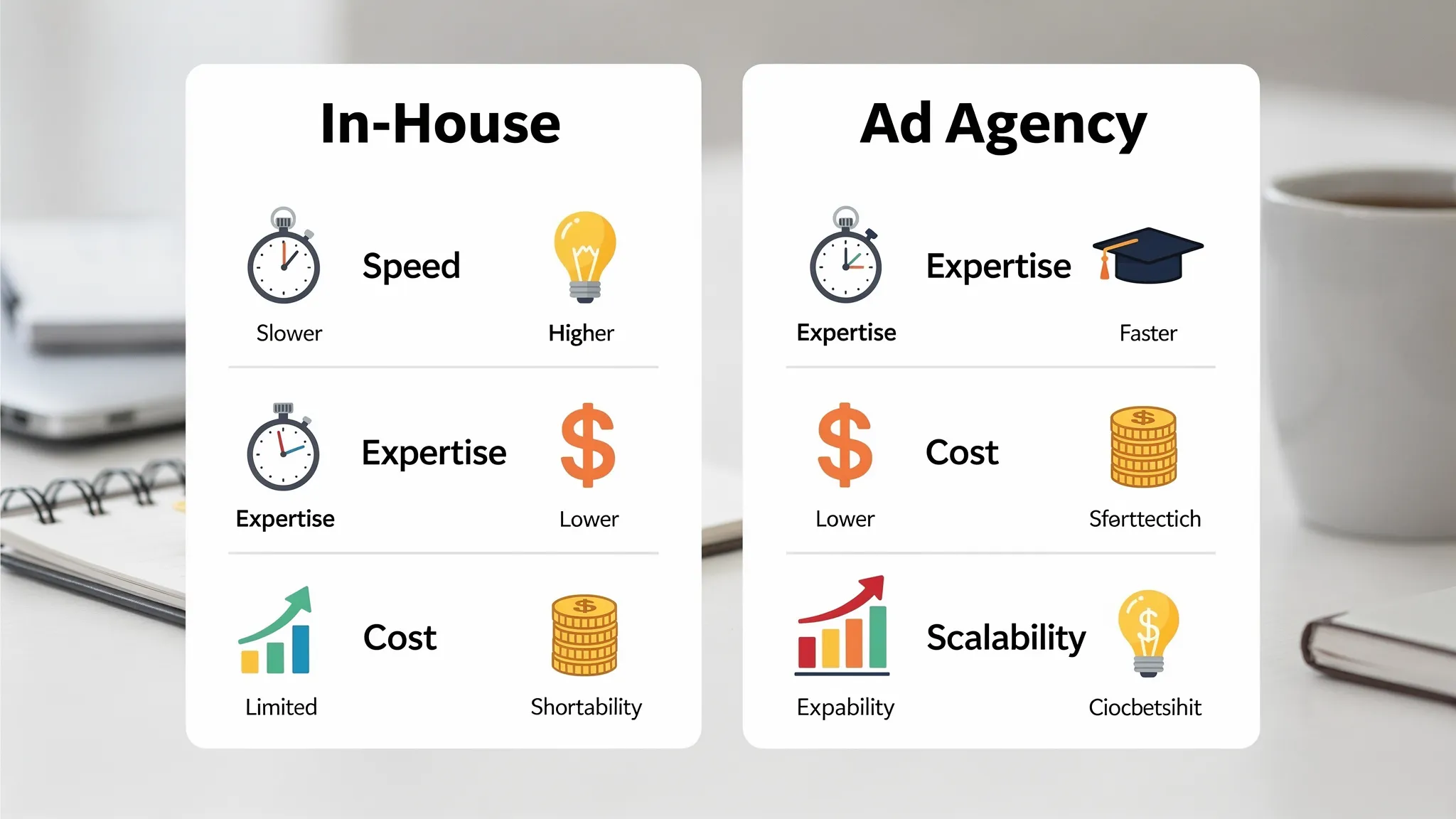
Quick comparison table
Use this table as a baseline, then adjust based on your reality (industry, competition, urgency, and internal capacity).
| Factor | In-house team | Ad agency |
|---|---|---|
| Speed to launch | Slower if hiring or training is needed | Faster if the agency already has a proven process |
| Depth of expertise | Depends on who you hire (often generalist early on) | Usually deeper in at least one channel (Google Ads, Meta Ads, SEO) |
| Total cost | Salary, taxes, tools, training, management time | Retainer or % fee, sometimes with add-ons |
| Accountability | Strong if goals and ownership are clear | Strong if scope, KPIs, and reporting are well defined |
| Institutional knowledge | High | Medium, improves with onboarding |
| Scalability | Limited by headcount | Easier to scale up or down with demand |
| Risk | Key-person risk if 1 person runs everything | Vendor risk if the agency is not a fit |
| Best fit | Businesses with stable budgets and ongoing marketing needs | Businesses that want faster execution and specialist support |
Cost reality: don’t compare “retainer vs salary” only
Many businesses compare an agency retainer to one employee salary and stop there. But the more realistic comparison is:
In-house fully loaded cost = salary + payroll taxes + benefits + tools + training + management time + hiring risk.
In the US, even a single experienced marketing hire can be expensive. The U.S. Bureau of Labor Statistics reports high median pay for marketing leadership roles, which is a useful reference point when estimating what senior capability costs in-house.
For local businesses, the in-house path often starts with a junior or generalist hire, then you “buy” senior expertise later via consultants or agencies anyway.
Agency cost should be evaluated against the value of:
- Launch speed (how soon you can start generating qualified leads)
- Reduced waste (fewer expensive mistakes in tracking, keywords, targeting, and landing pages)
- Continuous testing (creative iterations and conversion rate improvements)
If your market is competitive, a few months of inefficient spend can easily cost more than professional management.
A practical decision framework (choose based on your constraints)
Instead of debating preferences, answer these five questions.
1) How important is paid acquisition to your revenue in the next 90 days?
If you need leads fast (seasonality, new location, new offer, or you have capacity you must fill), an ad agency often wins because you can start immediately.
If paid ads are “nice to have” and growth is primarily referrals or partnerships right now, in-house experimentation can make sense.
2) Do you have the internal owner who can make ads succeed?
Even with an agency, growth usually requires internal ownership around:
- Offer clarity (what you sell, to whom, and why it is better)
- Sales follow-up speed (missed calls and slow responses kill ROI)
- Operations capacity (can you deliver if lead volume increases?)
If no one internally can own these pieces, hiring in-house will not automatically fix it. It just changes where the bottleneck sits.
3) Are you running one channel, or building a system?
If you only need one channel, for example Google Search Ads for “near me” intent, you can sometimes succeed with a focused in-house operator.
If you want a full system (landing pages, conversion tracking, remarketing, SEO content, creative testing), the coordination burden grows quickly. That is where a specialized ad agency or hybrid setup tends to outperform.
4) How confident are you in measurement and tracking?
If conversion tracking is wrong, every optimization decision becomes guesswork.
Ask yourself:
- Can we confidently attribute calls, form fills, and booked jobs to campaigns?
- Do we understand lead quality by source?
- Do we have a clear definition of a “qualified lead”?
If your answer is “not really,” an agency with strong measurement habits can create immediate lift by fixing the foundation.
For background on measurement expectations in Google Ads, see Google’s documentation on conversion tracking.
5) What is your risk tolerance for hiring?
Hiring is not just expensive, it is uncertain. The wrong hire can cost months of momentum.
If you have strong recruiting processes and a manager who can lead marketing execution, in-house becomes more attractive.
If you do not, agencies reduce hiring risk and let you “rent” experience while you learn what you actually need.
When in-house is usually the better choice
In-house tends to win when your business has reached a level where marketing is continuous and predictable.
Strong signals you should build in-house
You will often benefit from hiring internally if:
- You spend consistently on ads every month and plan to keep increasing spend.
- Your offers and messaging change frequently and require close product collaboration.
- You need deep brand consistency across creative, website, email, and sales enablement.
- You already have leadership that can manage marketers effectively.
The hidden advantage of in-house
The biggest benefit is not just “control.” It is compounding knowledge. Your team learns your customers, objections, seasonality, and what makes leads convert, and that learning stays inside the company.
When an ad agency is usually the better choice
An ad agency tends to win when you need specialist execution quickly, without building a department.
Strong signals you should outsource to an ad agency
An agency is often the best route if:
- You want to launch or relaunch campaigns quickly.
- You need multi-skill coverage (Google Ads, Meta Ads, landing pages, SEO basics, tracking).
- Your internal team is small and already at capacity.
- You want access to repeatable playbooks and benchmarks across many accounts.
The hidden advantage of an agency
A good agency brings pattern recognition: they have seen what works across many local businesses, including what fails. That experience can prevent expensive experimentation.
The hybrid model: the most common “best answer” for local businesses
For many local businesses, the highest ROI setup looks like this:
- In-house owns: positioning, offers, reviews, sales process, customer experience, and approvals.
- Agency owns: account structure, technical tracking, testing roadmap, weekly optimization, and performance reporting.
This reduces key-person risk internally while still keeping the business close to the customer and the brand.
Common mistakes to avoid (regardless of the model)
Mistake 1: Hiring or outsourcing before your offer is clear
If your offer is vague, ads become expensive. Clarify:
- Who you serve
- What problem you solve
- Why your solution is credible
- What the next step is (call, booking, estimate)
Mistake 2: Treating “leads” as the only KPI
Lead volume is easy to inflate. What matters is qualified leads that turn into revenue.
At minimum, track:
- Qualified lead rate
- Cost per qualified lead
- Close rate by source
- Revenue per lead (or at least average job value by source)
Mistake 3: Sending paid traffic to weak landing pages
Even great ads cannot consistently overcome slow pages, unclear calls-to-action, or pages that do not build trust.
If you are running Google Search Ads, your landing page should match search intent, show proof (reviews, photos, guarantees), and make contacting you frictionless.
Mistake 4: Expecting “set and forget” marketing
Growth marketing is iterative. Whether in-house or agency, you need a cadence for:
- Testing (ads, keywords, audiences, offers)
- Reviewing lead quality
- Improving conversion rates
A simple “choose your path” guide
Use these scenarios as a fast shortcut.
| Your situation | Likely best choice | Why |
|---|---|---|
| You need more leads within 30 to 60 days | Ad agency or hybrid | Faster time-to-launch and fewer setup mistakes |
| You have a stable monthly budget and clear internal leadership | In-house | Compounding learning and tighter integration |
| You want to scale across multiple channels | Hybrid | Keep business context in-house, outsource specialist execution |
| You are not confident in tracking and attribution | Ad agency (strong measurement) | Foundation work usually pays back quickly |
What to ask an ad agency (so you choose a good one)
A strong agency should be able to answer these clearly, without dodging.
- How do you define and report “qualified leads,” not just leads?
- What is your plan for conversion tracking and attribution?
- What does your first 30 days look like (audit, build, launch, testing)?
- How do you handle landing pages (in-house, guidance, or partners)?
- What does success look like at 90 days?
If the agency cannot explain process and measurement simply, expect chaos later.
Where Kvitberg Marketing fits (if you want a low-risk way to start)
If your biggest blocker is your website (or you are unsure your current site can convert paid traffic), Kvitberg Marketing offers a low-risk entry point: a free, finished, SEO-optimized website built for local businesses, with no upfront commitment. You review the completed site in a walkthrough meeting and only decide to buy if you like the result.
That model can be useful if you are considering an ad agency but do not want to invest heavily before you see quality. After the website foundation is in place, optional growth services like SEO campaigns and Google Search Ads management can support visibility and lead generation.
You can learn more at Kvitberg Marketing.

Frequently Asked Questions
Is it cheaper to hire in-house or use an ad agency? It depends on what level of expertise you need. In-house cost is more than salary (benefits, tools, training, hiring risk). An ad agency can be cheaper if you need specialist execution without building a full team, especially early on.
When should a small business hire its first in-house marketer? Typically when you have stable demand for ongoing marketing work, consistent budget, and leadership that can manage marketing performance. If you are still figuring out channels and messaging, outsourcing can be faster and less risky.
Can I run Google Ads myself successfully? Yes, especially for simple, high-intent local campaigns, but performance often suffers if tracking, landing pages, and negative keyword management are weak. If you rely on ads for growth, expert setup and ongoing optimization usually pays for itself.
What is the best model for local service businesses (plumbers, clinics, contractors)? Often a hybrid: keep offer, reviews, and sales follow-up internal, and outsource Google Ads management, tracking, and landing page optimization to specialists.
How do I know if my ad agency is doing a good job? You should see clear reporting tied to qualified leads and revenue outcomes, not vanity metrics. You should also see a testing roadmap, ongoing optimizations, and transparent explanations of what is being changed and why.
Want to grow without guessing?
If you are deciding between in-house and agency because you want more leads, start with the foundation that affects every channel: a website that converts and is built with SEO in mind. Kvitberg Marketing builds free, professional websites for local businesses, with no commitment upfront. You only choose to buy after you have seen the finished result.
Explore the offer and submit an inquiry at kvitbergmarketing.com.